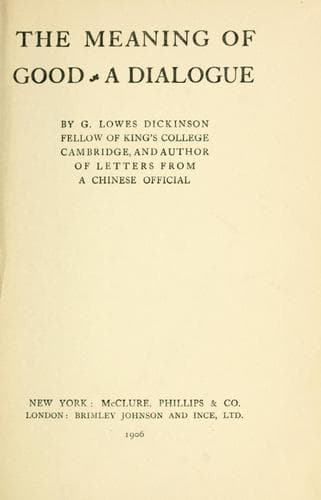
The Meaning of Good—A DialogueDickinson, G. Lowes (Goldsworthy Lowes)
Philosophy
The Meaning of Good—A Dialogue
Dickinson, G. Lowes (Goldsworthy Lowes)
Good and evil
(1) That our ideas about Good have no relation to any real fact.
(2) That we have easy and simple criteria of Good--such as (a)
an infallible instinct, (b) the course of Nature, (c) current
conventions, (d) pleasure.
(3) That all Reality is good, and all Evil is mere 'appearance.'
And it has been suggested that our experience is, or may be made, a
progressive discovery of Good.
In the following Book the question of the content of Good is
approached.
* * * * *
BOOK II.
This Book comprises an attempt to examine some kinds of Good, to point
out their defects and limitations, and to suggest the character of
a Good which we might hold to be perfect--here referred to as '_The_
Good.'
The attitude adopted is tentative, for it is based on the position, at
which we are supposed to have arrived, that the experience of any one
person, or set of persons, about Good is limited and imperfect, and
that therefore in any attempt to describe what it is that we hold
to be good, to compare Goods among one another, and to suggest
an absolute Good, we can only hope, at best, to arrive at some
approximation to truth.
I. This attitude is explained at the outset, and certain preliminary
points are then discussed. These are:
(1) Can any Good be an end for us unless it is conceived to be an
object of consciousness? The negative answer is suggested.
(2) In pursuing Good, for whom do we pursue it? It is suggested that
the Good we pursue is
(a) That of future generations. Some difficulties in this view are
brought out; and it is hinted that what we really pursue is the Good
of 'the Whole,' though it is not easy to see what we mean by that.
(b) That of 'the species.' But this view too is seen to be involved
in difficulty.
II. The difficulty is left unsolved, and the conversation passes on
to an examination of some of our activities from the point of view
of Good. In this examination a double object is kept in view: (1) to
bring out the characteristics and defects of each kind of Good; (2) to
suggest a Good which might be conceived to be free from defects, such
a Good being referred to as '_The_ Good.'
(1) It is first suggested that _all_ activities are good, if pursued
in the proper order and proportion; and that what seems bad in each,
viewed in isolation, is seen to be good in a general survey of them
all. This view, it is argued, is too extravagant to be tenable.
(2) It is suggested that Good consists in ethical activity. To this it
is objected that ethical actions are always means to an end, and that
it is this end that must be conceived to be really good.
(3) The activity of the senses in their direct contact with physical
objects is discussed. This is admitted to be a kind of Good; but
such Good, it is maintained, is defective, not only because it is
precarious, but because it depends upon objects of which it is not the
essence to produce that Good, but which, on the contrary, just as much
and as often produce Evil.
Public-domain text, read in full here on John Shaqi.
Reviews
Reviews
No reviews yet
Be the first to share your thoughts on this work.
Join the Discussion
Join the discussion
Sign in to leave a comment or review.
Sign InorCreate an account