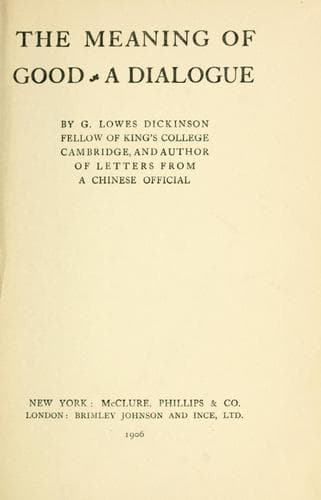
The Meaning of Good—A DialogueDickinson, G. Lowes (Goldsworthy Lowes)
Philosophy
The Meaning of Good—A Dialogue
Dickinson, G. Lowes (Goldsworthy Lowes)
Good and evil
(4) This leads to a discussion of Art. In Art, it seems, we are
brought into relation with objects of which it may be said:
(a) That they have, by their essence, that Good which is called
Beauty.
(b) That, in a certain sense, they may be said to be eternal.
(c) That, though complex, they are such that their parts are
necessarily connected, in the sense that each is essential to the
total Beauty.
On the other hand, the Good of Art suffers from the defects:
(a) That outside and independent of Art there is the 'real world,'
so that this Good is only a partial one.
(b) That Art is a creation of man, whereas we seem to demand, for
a thing that shall be perfectly good, that it shall be so of its own
nature, without our intervention.
(5) It is suggested that perhaps we may find the Good we seek in
knowledge. This raises the difficulty that various views are held as
to the nature of knowledge. Of these, two are discussed:
(a) the view that knowledge is 'the description and summing up in
brief formulæ, of the routine of our perceptions.' It is questioned
whether there is really much Good in such an activity. And it is
argued that, whatever Good it may have, it cannot be _the_ Good,
seeing that knowledge may be, and frequently is, knowledge of Bad.
(b) the view that knowledge consists in the perception of 'necessary
connections,' Viewed from the standpoint of Good, this seems to be
open to the same objection as (a). But, further, it is argued that
the perpetual contemplation of necessary relations among ideas does
not satisfy our conception of the Good; but that we require an
element analogous somehow to that of sense, though not, like sense,
unintelligible and obscure.
(6) Finally, it is suggested that in our relation to other persons,
where the relation takes the form of love, we may perhaps find
something that comes nearer than any other of our experiences to being
absolutely good. For in that relation, it is urged, we are in contact
(a) with objects, not 'mere ideas.'
(b) with objects that are good in themselves and
(c) intelligible and
(d) harmonious to our own nature.
It is objected that love, so conceived, is
(a) rarely, perhaps never, experienced.
(b) in any case, is neither eternal nor universal.
This is admitted; but it is maintained that the best love we know
comes nearer than anything else to what we might conceive to be
absolutely good.
III. The question is now raised: if 'the Good' be so conceived, is it
not clearly unattainable? The answer to this question seems to depend
on whether or not we believe in personal immortality. The following
points are therefore discussed:
(a) Whether personal immortality is conceivable?
(b) Whether a belief in it is essential to a reasonable pursuit of
Good?
On these points no dogmatic solution is offered; and the Dialogue
closes with the description of a dream.
BOOK I.
Public-domain text, read in full here on John Shaqi.
Reviews
Reviews
No reviews yet
Be the first to share your thoughts on this work.
Join the Discussion
Join the discussion
Sign in to leave a comment or review.
Sign InorCreate an account