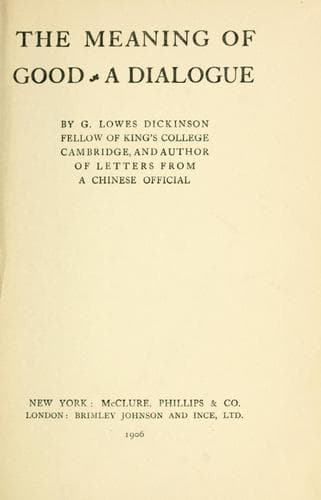
The Meaning of Good—A DialogueDickinson, G. Lowes (Goldsworthy Lowes)
Philosophy
The Meaning of Good—A Dialogue
Dickinson, G. Lowes (Goldsworthy Lowes)
Good and evil
Every summer, for several years past, it has been my custom to arrange
in some pleasant place, either in England or on the continent, a
gathering of old college friends. In this way I have been enabled
not only to maintain some happy intimacies, but (what to a man of
my occupation is not unimportant) to refresh and extend, by an
interchange of ideas with men of various callings, an experience of
life which might be otherwise unduly monotonous and confined. Last
year, in particular, our meeting was rendered to me especially
agreeable by the presence of a very dear friend, Philip Audubon, whom,
since his business lay in the East, I had not had an opportunity of
seeing for many years. I mention him particularly, because, although,
as will be seen, he did not take much part in the discussion I am
about to describe, he was, in a sense, the originator of it. For, in
the first place, it was he who had invited us to the place in which we
were staying,--an upland valley in Switzerland, where he had taken a
house; and, further, it was through my renewed intercourse with him
that I was led into the train of thought which issued in the following
conversation. His life in the East, a life laborious and monotonous
in the extreme, had confirmed in him a melancholy to which he was
constitutionally inclined, and which appeared to be rather heightened
than diminished by exceptional success in a difficult career. I
hesitate to describe his attitude as pessimistic, for the word has
associations with the schools from which he was singularly free. His
melancholy was not the artificial product of a philosophic system; it
was temperamental rather than intellectual, and might be described,
perhaps, as an intuition rather than a judgment of the worthlessness
and irrationality of the world. Such a position is not readily shaken
by argument, nor did I make any direct attempt to assail it; but it
could not fail to impress itself strongly upon my mind, and to keep
my thoughts constantly employed upon that old problem of the worth
of things, in which, indeed, for other reasons, I was already
sufficiently interested.
A further impulse in the same direction was given by the arrival of
another old friend, Arthur Ellis. He and I had been drawn together
at college by a common interest in philosophy; but in later years our
paths had diverged widely. Fortune and inclination had led him into
an active career, and for some years he had been travelling abroad
as correspondent to one of the daily papers. I felt, therefore, some
curiosity to renew my acquaintance with him, and to ascertain how far
his views had been modified by his experience of the world.
Public-domain text, read in full here on John Shaqi.
Reviews
Reviews
No reviews yet
Be the first to share your thoughts on this work.
Join the Discussion
Join the discussion
Sign in to leave a comment or review.
Sign InorCreate an account