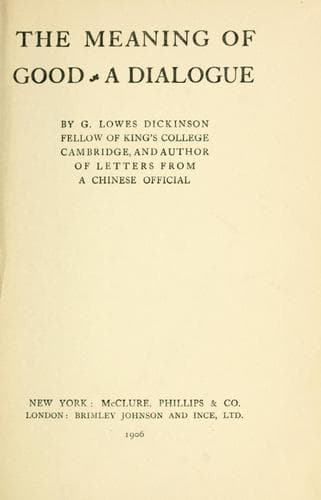
The Meaning of Good—A DialogueDickinson, G. Lowes (Goldsworthy Lowes)
Philosophy
The Meaning of Good—A Dialogue
Dickinson, G. Lowes (Goldsworthy Lowes)
Good and evil
The morning after his arrival he joined Audubon and myself in a kind
of loggia at the back of the house, which was our common place of
rendezvous. We exchanged the usual greetings, and for some minutes
nothing more was said, so pleasant was it to sit silent in the shade
listening to the swish of scythes (they were cutting the grass in
the meadow opposite) and to the bubbling of a little fountain in the
garden on our right, while the sun grew hotter every minute on the
fir-covered slopes beyond. I wanted to talk, and yet I was unwilling
to begin; but presently Ellis turned to me and said: "Well, my dear
philosopher, and how goes the world with you? What have you been doing
in all these years since we met?"
"Oh," I replied, "nothing worth talking about."
"What have you been thinking then?"
"Just now I have been thinking how well you look. Knocking about the
world seems to suit you."
"I think it does. And yet at this moment, whether it be the quiet of
the place, or whether it be the sight of your philosophic countenance,
I feel a kind of yearning for the contemplative life. I believe if
I stayed here long you would lure me back to philosophy; and yet I
thought I had finally escaped when I broke away from you before."
"It is not so easy," I said, "to escape from that net, once one is
caught. But it was not I who spread the snare; I was only trying to
help you out, or, at least, to get out myself."
"And have you found a way?"
"No, I cannot say that I have. That's why I want to talk to you and
hear how you have fared."
"I? Oh, I have given the whole subject up."
"You can hardly give up the subject till you give up life. You may
have given up reading books about it; and, for that matter, so have I.
But that is only because I want to grapple with it more closely."
"What do you do, then, if you do not read books?"
"I talk to as many people as I can, and especially to those who have
had no special education in philosophy; and try to find out to what
conclusions they have been led by their own direct experience."
"Conclusions about what?"
"About many things. But in particular about the point we used to be
fondest of discussing in the days before you had, as you say, given
up the subject--I mean the whole question of the values we attach, or
ought to attach, to things."
"Oh!" he said, "well, as to all that, my opinion is the same as of
old. 'There's nothing good or bad but thinking makes it so,' So I used
to say at college and so I say now."
"I remember," I replied, "that that is what you always used to say;
but I thought I had refuted you over and over again."
"So you may have done, as far as logic can refute; but every bit of
experience which I have had since last we met has confirmed me in my
original view."
"That," I said, "is very interesting, and is just what I want to hear
about. What is it that experience has done for you? For, as you
know, I have so little of my own, I try to get all I can out of other
people's."
Public-domain text, read in full here on John Shaqi.
Reviews
Reviews
No reviews yet
Be the first to share your thoughts on this work.
Join the Discussion
Join the discussion
Sign in to leave a comment or review.
Sign InorCreate an account