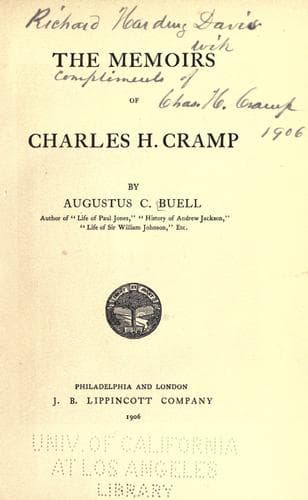
Cramp, Charles Henry, 1828-1913; Naval architects -- United States -- Biography
Indeed, before 1750, England had begun to import ship-timber from the
Baltic; but it was mostly deal boards used for cabin-work, ceilings,
sheathings, etc. Now she began to look to her American Colonies for the
heavier materials. It was difficult to load and stow this kind of timber
through the hatchways of the ships then available. The ingenuity of
Philadelphia shipwrights met this obstacle by building the timbers
themselves into the form of ships, and they were then navigated across
the Atlantic to be broken up on arrival in British ports. These
“raft-ships” were built with bluff bows and square sterns, their sides
being several feet thick. To make them water-tight, they were sheathed
with two thicknesses of boards which “broke joints,” and were caulked.
The largest of these, called the “Baron Renfrew,” measured the
equivalent of five thousand tons in a regular merchant ship. She got
safely across the ocean, but went ashore on Portland Bill in a fog and
broke up. Most of her timber, however, was picked up by English and
French vessels which cruised for weeks in search of it. Among the
mast-timber she carried was one white pine tree ninety-one feet long by
four feet eight inches diameter at the butt inside the bark. This tree
was used for the mainmast of the “Royal George,” a three-decker then
building at Chatham (1774). It was doubtless still in the ill-fated ship
when she heeled over and went down at Portsmouth in 1782. The “Baron
Renfrew” was the last of the “raft-ships.” The oncoming Revolution
stopped all kinds of commerce for eight years, and though after the
peace ship-timber was again exported to England, it went as hold or deck
cargo in regular vessels.
Summing up the colonial period, it may be said that, while the records
were imperfectly kept and some lost, enough is extant to show that
between 1684 and 1744 one hundred and eighty-eight square-rigged ships
and over seven hundred brigs and schooners, besides immense numbers of
boats, river-sloops, fishing-yawls, etc., were built at Philadelphia.
Her only rival in the Colonies during that period was Portsmouth, New
Hampshire, but Philadelphia held the ascendency over all in the size and
total tonnage of her ships.
That the Colonies should have developed the ship-building industry from
their earliest existence was natural and necessary. If you take a modern
map of the United States and draw from Maine to Georgia a heavy black
line averaging one hundred miles back from the general trend of the
sea-coast, you will have in close approximation the geography of
colonial settlement at its maximum. In this belt, this “narrow fringe of
civilization,” were concentrated for more than a century all the
energies of English-speaking pioneers, rapidly increasing in numbers and
incessantly augmenting the products of enterprise and industry which,
from surplus over home consumption, had to seek markets over sea.
Public-domain text, read in full here on John Shaqi.
Reviews
Reviews
No reviews yet
Be the first to share your thoughts on this work.
Join the Discussion
Join the discussion
Sign in to leave a comment or review.
Sign InorCreate an account