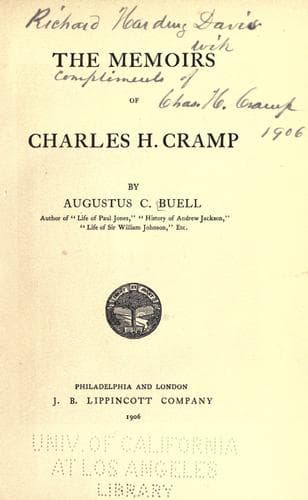
Cramp, Charles Henry, 1828-1913; Naval architects -- United States -- Biography
The first vessel described afterward became the “New Ironsides.” Her
hull was designed entirely by Mr. Cramp. Generally speaking, her type
was that of a broadside sea-going iron-clad. She was a roomy,
comfortable ship for her officers and crew. Her fighting quarters were
well protected against the shot of that day. Although engaged with forts
and batteries a greater number of times than any other one vessel in the
service, her armor was never pierced.
Perhaps at this point a description of the vessel and the conditions
attending her construction, in the form of a paper read some years ago
by Mr. Cramp before the Contemporary Club, of Philadelphia, will be more
pointed and interesting than any other delineation.
It is as follows:
“NEW IRONSIDES”
“When the ‘New Ironsides’ was contracted for there was no white oak
timber available outside of Pennsylvania. Timber of this kind was
cleaned out in Delaware and Maryland, and Virginia was for the
time-being inaccessible. So the timber that must be used was growing
in the forests of Pennsylvania when the contract was signed.
“With the exception of pine decking every stick of timber was of
white oak, and being the largest wooden ship ever built, the frames
were very heavy,—the floor timbers were two to each frame, and,
being without first futtocks and running from bilge to bilge, they
required a tree large enough to be twenty-two inches in diameter at
a height of forty-five feet from the ground. Trees of this kind were
very scarce in Pennsylvania, and frequently only a single tree would
be found in a township, which had been preserved as an heirloom by
the owner, and it was often difficult to persuade him to sell.
“During the month of October, 1861, we advertised in the country
papers that we would pay a dollar a running foot for every tree that
was brought to us by the first of January, under the requirements
that they were to be at least twenty-two inches in diameter at
forty-five feet from the ground, and the logs were to be sided on
two sides anywhere from thirteen inches up to eighteen inches.
Public-domain text, read in full here on John Shaqi.
Reviews
Reviews
No reviews yet
Be the first to share your thoughts on this work.
Join the Discussion
Join the discussion
Sign in to leave a comment or review.
Sign InorCreate an account