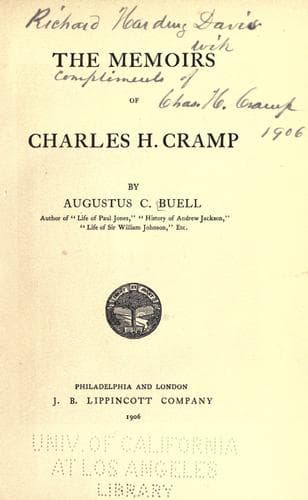
Cramp, Charles Henry, 1828-1913; Naval architects -- United States -- Biography
“At this time, the beginning of the war, farming and business in
country towns being very slack, all suitable trees in the forests of
Bucks, Berks, Delaware, and Chester counties and some counties more
remote were prospected by the country-people and farmers, who worked
very hard utilizing moonlight nights as well as daytime in cutting
and shipping this timber. These counties were traversed by the North
Pennsylvania Railroad, and the various stations from Quakertown down
were soon gorged with logs that had to be delivered at our shipyard
on or before the first of January to meet our requirements. By the
first of January we had logs sufficient to make all the floors of
the ship, and quite a number were left at the stations where they
had accumulated too rapidly for the railroad to handle them, and
they could not be delivered within our time limit. This timber was
afterward bought at a reduced price.
“Not being able to get yellow pine, the beams and water-ways were
made of white oak. Some of these pieces were sixty feet long and
were sided up to sixteen inches. But notwithstanding these
difficulties and the fact that all the frame-timber was standing in
the forest when we took the contract, yet the vessel was launched in
six months after it was signed.
“The region traversed by the North Pennsylvania Railroad in
furnishing the frames, water-ways, and beams became exhausted in its
turn, so that toward the termination of the war white oak for the
beams of the light-draught monitors had to be procured chiefly in
Columbia County, in the interior of the State of Pennsylvania.
“There was also difficulty in securing timber for the curved
futtocks, which were principally made of roots and were obtained
from Delaware.
“The frames were fitted together solidly and caulked before ceiling
or planking was secured, and the outside planking below the lower
edge of armor was twelve inches thick, tapering off to the lower
turn of the bilge to five inches. So the ship in her defensive
capabilities was a war machine of no mean type.
“If the ship had been built of steel instead of wood, she would have
been sunk when she was struck by a spar torpedo off Charleston.
Public-domain text, read in full here on John Shaqi.
Reviews
Reviews
No reviews yet
Be the first to share your thoughts on this work.
Join the Discussion
Join the discussion
Sign in to leave a comment or review.
Sign InorCreate an account