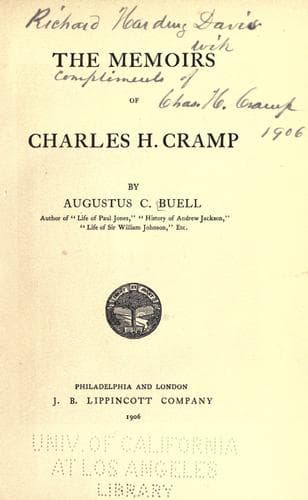
Cramp, Charles Henry, 1828-1913; Naval architects -- United States -- Biography
“About three months after we began work, and when the frames were up
and the beams in, the Department decided to arm the ship with
fourteen 11-inch Dahlgrens in broadside and two 200-pounders (8-inch
Parrotts). They were all muzzle loaders. This, together with the
increased weight of ammunition for the larger guns, exactly consumed
my foot of margin and brought the port-sills down to the normal
height of seven feet above water, and the draught of ship there was
not over fifteen feet, the original design.
“It may not be improper to say that I received much credit and
congratulation from the Board and others for my foresight in
allowing the margin as I did, and for the correctness of my
calculations. But for that the modified battery would have brought
the port-sills down to six feet or less, which would have rendered
it dangerous to open the main-deck ports in much of a sea.
“During the earlier stages of the construction of this ship but
little attention was paid to it by the people of the country; the
exciting conditions of the war on land; battles won and lost; the
movement of troops, etc., occupied the entire attention of the
people; so that while the yard was left open and no fence around it
there were no visitors.
“When the battle between the ‘Monitor’ and ‘Merrimac’ took place a
short time before launching the ‘New Ironsides,’ the whole world was
aroused, and their attention was called to the fact that there were
such things as armor-clad ships.
“When the number of visitors who applied for admission was so great
that we had to build a high fence around the shipyard, and only
admitted those who secured tickets issued by us, and when the launch
took place, it was under conditions of great excitement and
enthusiasm. The completion of the ship was accomplished in a very
short time, and her first scene of operations was before Fort
Sumter, which she bombarded eleven months and two days after the
contract was signed.
“At this point the history of the contracts may be stated:
“When the appropriation was made by Congress for the purpose of
constructing iron-clads, the Secretary of the Navy, as has been
remarked, created a board on armored ships, consisting of Commodores
Paulding, Smith, and Davis, who were fully authorized to carry out
the provisions of the law and make contracts, keeping in view what
had been done by England and France in the way of iron-plated
floating batteries. These gentlemen advertised for plans and
specifications accompanied by proposals for accomplishing the
purpose of the act of Congress. There were twenty-five or thirty
proposals, embracing a great diversity of projects, the principal
features of most of which were lack of well-defined plan, type, and
character.
Public-domain text, read in full here on John Shaqi.
Reviews
Reviews
No reviews yet
Be the first to share your thoughts on this work.
Join the Discussion
Join the discussion
Sign in to leave a comment or review.
Sign InorCreate an account