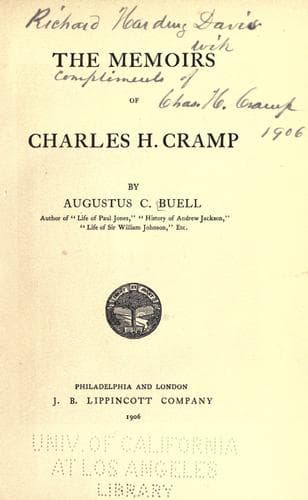
Cramp, Charles Henry, 1828-1913; Naval architects -- United States -- Biography
“In using the words ‘in saving the country,’ Bishop Simpson looked
on the fight between the ‘Monitor’ and the ‘Merrimac’ as a great
many other people did; that is to say, if the ‘Merrimac’ had
escaped, she would have bombarded Philadelphia and New York and
other cities of the North, thereby compelling the government to
submit to the South. But the ‘Monitor’ having destroyed her before
she got out, John Ericsson was therefore entitled to all the credit
due to a person who had been specially delegated by the Almighty for
saving the country. John Ericsson had already become famous on
account of conspicuous efforts in promoting screw propulsion in the
United States generally, and particularly with reference to the use
in war-ship construction. In view of his unceasing labors in this
direction his name had become inseparably associated with the screw
propeller. This added much to the enthusiasm that prevailed at that
time, and all minor considerations being overlooked. It was
discovered a very short time after the war was ended that, even if
the ‘Merrimac’ could have escaped at that time from her encounters
with the ‘Cumberland,’ ‘Congress,’ and ‘Monitor,’ it would have been
impossible for her to go as far north as Philadelphia or New York.
It was found that she was in a very badly crippled state as a result
of her ramming the ‘Cumberland’ and ‘Congress;’ and the statement
was made by those who temporarily repaired her in Norfolk that her
bow was split to a great distance below the water.
“To use the words of one of the workmen, he had ‘put more than a
bale of oakum in the opening.’
“The construction of the ‘New Ironsides,’ ‘Monitor,’ and ‘Galena’
had already been practically taken out of the hands of the
Construction Department of the Navy by the Secretary of the Navy,
who became a convert to the monitor craze after the battle with the
‘Merrimac.’ The ‘Monitor’ had become the ideal type of armored
war-ship, and a sort of sub-department of the navy was created and
located at New York for the sole purpose of building and fitting out
monitors.
“This establishment in New York was placed under the immediate
supervision of Admiral Gregory, the active head being Chief Engineer
A. G. Stimers, who had been the chief engineer of the ‘Monitor’
during her engagement with the ‘Merrimac.’ He had associated with
him Isaac Newton and Theodore Allen, the nephew of Mr. Allen of the
Novelty Works in New York. This board was in direct communication
with the Secretary of the Navy.
“The monitor party, which may be described as the executive of the
ring or the New York section of the Navy Department, soon assumed a
position of great power and responsibility; the balance of the
Department amounting to practically mere nothing in the way of new
construction.
Public-domain text, read in full here on John Shaqi.
Reviews
Reviews
No reviews yet
Be the first to share your thoughts on this work.
Join the Discussion
Join the discussion
Sign in to leave a comment or review.
Sign InorCreate an account