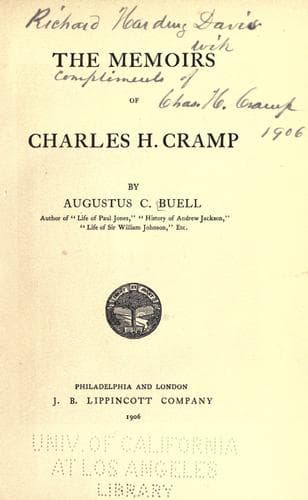
Cramp, Charles Henry, 1828-1913; Naval architects -- United States -- Biography
In 1750-51 two ships were built in West’s new yard, which exceeded in
size any merchant vessels previously constructed in America. One of them
was of three hundred and twenty and the other of four hundred tons
burthen. They were sent to England with cargoes of colonial produce, and
on arrival at London were both bought by the East India Company and
placed in the regular East India and China fleet. They were as large as
any merchant vessels built in England up to that time, and of superior
model and construction. One of them—the larger of the two—remained on
the list of the East India Company more than thirty years; and in 1751
had for one of her passengers to India, Warren Hastings, who was going
out to Madras as a young clerk in the Civil Service, to become the first
Governor-General of British India, and founder of the British Empire in
Asia.
During this period, the third quarter of the eighteenth century, a new
scheme of ship-building commended itself to the enterprise and ingenuity
of Philadelphia shipwrights. This was the construction of what they
called “raft-ships.”
The local supply of ship-timber in the forests of England, particularly
of frames, knees, keels, and the larger spars, had begun to decline to
the danger-point by 1750. The size of ships, both for commerce and for
war, was constantly increasing. This increase incessantly involved the
use of longer and heavier timbers for frames, larger knees and futtocks,
and thicker planking. Meantime the forests of England became smaller and
smaller. The great old trees had been cut down and sawed or hewn up, and
the younger stems had not found time to grow in their stead.
Public-domain text, read in full here on John Shaqi.
Reviews
Reviews
No reviews yet
Be the first to share your thoughts on this work.
Join the Discussion
Join the discussion
Sign in to leave a comment or review.
Sign InorCreate an account