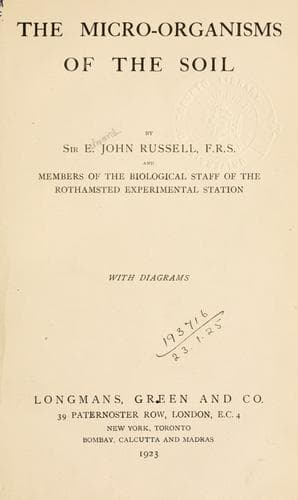
The micro-organisms of the soilRussell, Edward J. (Edward John)
Science
The micro-organisms of the soil
Russell, Edward J. (Edward John)
Soil microbiology
Owing to the method by which our knowledge of soil bacteria has been
acquired, by studying first the chemical changes in the soil and then
the bacteria that produce them, it is natural for us to divide them
into physiological groups according to the chemical changes that they
bring about. This grouping is the more reasonable since so little is
known as to the true relationships of the different groups of bacteria
that a classification based on morphology is well-nigh impossible. In
considering the activities of bacteria in the soil, it is convenient to
group the changes which they bring about into the two divisions into
which they naturally fall in the economy of the organisms.
In the first place, there are the changes that result in a release of
energy, which the bacteria utilise for their vital processes.
In the second place, there are the processes by which the bacteria
build up the material of their bodies. These building up processes
involve an intake of energy for their accomplishment.
It will be convenient to deal first with the release of energy for
their own use by bacteria, and its consequences.
_B._ ACTIVITIES CONNECTED WITH THE ACQUIREMENT OF ENERGY.
Unlike the green plants, most bacteria are unable to obtain the energy
that is required for their metabolism from sunlight. They must,
therefore, make use of such chemical changes as will involve the
release of energy.
As an example of the acquirement of energy in this way may be taken the
oxidation of methane by _B. methanicus_. This organism, described by
Söhngen, obtains its energy supply by the conversion of methane into
CO₂ and H₂O.
CH₄ + 2O₂ = CO₂ + 2H₂O 220 Cal.
A further example is the acetic organism that obtains its energy
through the oxidation of alcohol to acetic acid.
C₂H₆O + O₂ = C₂H₄O₂ + H₂O 115 Cal.
The decomposition processes brought about by micro-organisms in
obtaining energy are usually oxidations, but this is not necessarily
so, as can be seen in case of the fermentation of sugar into alcohol.[E]
C₆H₁₂O₆ = 2C₂H₆O + 2CO₂ 50 Cal.
[E] These examples are from Orla-Jensen (Centralblatt f. Bakt., II.,
Bd. 22, p. 305).
By far the greater part of the decomposition of organic matter is
brought about by bacteria in the process of acquiring energy. In the
soil, nearly the whole of the material utilised by bacteria as a source
of energy is derived ultimately from green plants. The energy materials
left in the soil by the plant fall into two groups, the non-nitrogenous
compounds, which are mainly carbohydrates and their derivatives, and
the nitrogenous compounds, principally derived from proteins.
(1) _Decomposition of Non-nitrogenous Compounds._
The simpler carbohydrates and starches are attacked and decomposed by
a large variety of bacteria. The addition of such substances to soil
causes a rapid increase in bacterial numbers. In nature the sugars are
in all probability among the first plant constituents to be destroyed
during the decay processes.
Public-domain text, read in full here on John Shaqi.
Reviews
Reviews
No reviews yet
Be the first to share your thoughts on this work.
Join the Discussion
Join the discussion
Sign in to leave a comment or review.
Sign InorCreate an account