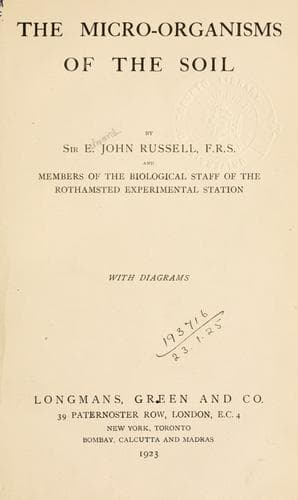
The micro-organisms of the soilRussell, Edward J. (Edward John)
Science
The micro-organisms of the soil
Russell, Edward J. (Edward John)
Soil microbiology
On account of its energetic fixation of nitrogen in culture media,
_Azotobacter_ has attracted the greatest attention of workers. The
evidence seems to be consistent with the view that _Azotobacter_ is of
importance in the soil. Thus the distribution of _Azotobacter_ would
appear to be world-wide. It is found all over Western Europe and the
United States. Lipman and Burgess[45] found it in soils collected from
Italy and Spain, Smyrna, Cairo, the Fayum, the Deccan in India, Tahiti,
Hawaii, Mexico, Guatemala, and Canada. C. M. Hutchinson[29] found it
to be distributed throughout India. It was found by Omelianski[55]
to be widely distributed in European and Asiatic Russia, and by
Groenewege[28] in Java. Ashby[1] at Rothamsted, isolated it from soils
from the Transvaal, East Africa, and Egypt. Also, an association has
sometimes been found between the ability of a soil to fix nitrogen and
the occurrence and vigour of its _Azotobacter_ flora. Thus Lipman and
Waynick[46] found that if soil from Kansas were removed to California,
its power to produce a growth of _Azotobacter_, when inoculated into a
suitable medium, was lost, and, at the same time, its nitrogen-fixing
power was greatly reduced. Moreover, it is known that conditions
favourable to the fixation of nitrogen by _Azotobacter_ in cultures on
the whole favour nitrogen fixation in soils. The conditions that favour
other aerobic nitrogen-fixing bacteria are, however, not sufficiently
distinct to make such evidence of great value.
It is usually found that nitrogen fixation is most active in
well-aerated soil. Thus Ashby,[1] at Rothamsted, found the
nitrogen-fixing power of a soil to decrease rapidly with depth. Similar
results were obtained in Utah by Greaves. This suggests, at first
sight, that anaerobic nitrogen fixers are unimportant under normal
soil conditions. It is, however, quite possible that they may assume
an importance when acting in conjunction with aerobic organisms.
Thus Omelianski and Salunskov[55] found that beneficial association,
or symbiosis, could occur between _Azotobacter_ and _Clostridium
pasteurianum_, the former absorbing oxygen from the surroundings, and
thus creating a suitable anaerobic environment for the _Clostridium_.
Public-domain text, read in full here on John Shaqi.
Reviews
Reviews
No reviews yet
Be the first to share your thoughts on this work.
Join the Discussion
Join the discussion
Sign in to leave a comment or review.
Sign InorCreate an account