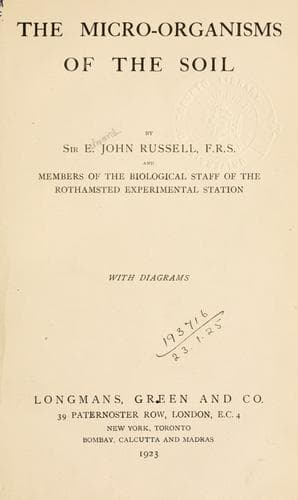
The micro-organisms of the soilRussell, Edward J. (Edward John)
Science
The micro-organisms of the soil
Russell, Edward J. (Edward John)
Soil microbiology
The question of symbiosis of nitrogen-fixing bacteria with each other
and with other organisms offers an inviting field for research.
There is evidence that this factor may have considerable importance.
Beijerinck and Van Delden[3] early recognised that _Azotobacter_
in mixed cultures fixed more nitrogen than in pure cultures.
_Granulobacter_, an organism which they found to be commonly associated
with _Azotobacter_ in crude cultures, appears to increase its
nitrogen-fixing powers (Krzeminiewski).[41] It was also found by
Hanzawa[31] that a greater fixation of nitrogen was obtained when two
strains of _Azotobacter_ were grown together. A symbiosis between
_Azotobacter_ and green algæ has been described, and will be further
discussed by Dr. Bristol. It is likely that this association may be of
importance under suitable conditions on the soil surface where the algæ
are exposed to light.
The combination of elemental nitrogen is an endothermic process which
requires a very considerable amount of energy for its accomplishment.
This fact is well illustrated by the various commercial processes
in use for fixation of atmospheric nitrogen. The nitrogen-fixing
bacteria obtain this energy from the carbon compounds in the soil.
A number of compounds were compared as sources of energy by Löhnis
and Pillai,[47] who tested their effect on the amounts of nitrogen
fixed by _Azotobacter_ in culture. It was found that mannitol and the
simpler sugars give the best results as sources of energy, but that
other organic compounds can also be used. Mockeridge[51] has adduced
evidence that ethylene glycol, methyl-, ethyl-, and propyl-alcohol,
lactic, malic, succinic, and glycocollic acids could also be utilised.
Since so large a part of the organic matter added to soil is in the
form of celluloses, it is of great importance to ascertain how far
these compounds and their decomposition products can be utilised in
nitrogen fixation. Stubble, corn-stalks and roots, oak leaves, lupine
and lucerne tops, maple leaves, and pine needles may all serve as
useful sources of energy to nitrogen-fixing organisms in the soil. Pure
cellulose cannot apparently be used as a source of energy, but when
acted upon by cellulose decomposing organisms, it becomes available as
a source of energy. Hutchinson and Clayton, at Rothamsted, found that
a fixation of nitrogen could be brought about by mixed cultures of
_Azotobacter_, and of the cellulose attacking _Spirochæta cytophaga_,
when grown in cultures containing pure cellulose. It is not known
how far cellulose decomposition must proceed to produce an effective
source of energy, nor what are the substances thus produced that are
utilised. This point will not be decided until something more is known
of the course of changes in the breaking-down of cellulose in the soil.
Public-domain text, read in full here on John Shaqi.
Reviews
Reviews
No reviews yet
Be the first to share your thoughts on this work.
Join the Discussion
Join the discussion
Sign in to leave a comment or review.
Sign InorCreate an account