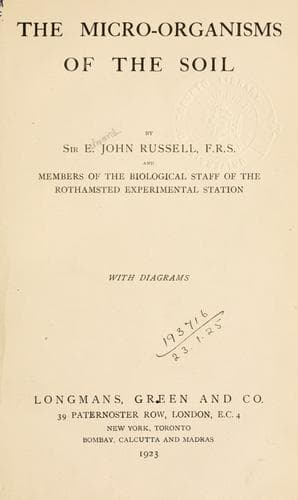
The micro-organisms of the soilRussell, Edward J. (Edward John)
Science
The micro-organisms of the soil
Russell, Edward J. (Edward John)
Soil microbiology
The importance of this work in connection with soil fertility
was immediately realised by Warington, who had recently come to
Rothamsted.[11] He quickly confirmed the result, and made the valuable
discovery that two stages were involved--the conversion of ammonia to
a nitrite by one organism, and of the nitrite to nitrate by another.
He made long and persistent attempts to isolate the organisms from the
soil, using the best technique of his time, but though he found many
bacteria none of them could nitrify ammonium salts; yet the soil did
it easily. For years he continued his efforts to find the nitrifying
organism, but always failed. His health was not good, his life at
Rothamsted was not happy owing to disagreements with Gilbert, and
although his other research work was succeeding, this investigation
on which he had set his heart was not coming out; bacterial technique
was not yet sufficiently far advanced. Ten bitter, disappointing years
passed, and the crown of disappointment came when Winogradsky, a young
bacteriologist in Paris, changed the technique and succeeded at once in
isolating both the nitrite and the nitrate-forming organisms.[13]
The numerous bacteria found by Warington in the soil suggested the
presence of a soil population, and this idea was greatly strengthened
by another line of investigation which was being followed up in France.
Boussingault had shown that soils absorb oxygen and give out carbon
dioxide; Schloesing extended this discovery, as also did Wollny. It
was concluded that oxidation was the result of the activities of the
soil organisms in decomposing the organic matter of the soil, and thus
preparing the way for the nitrifying organisms.
A third important function of soil bacteria was revealed by
Berthelot.[1] It was known that considerable loss of nitrogen from the
soil took place as the result of the conversion of nitrogen compounds
into nitrates, which were subsequently washed out in the drainage
water. It followed inevitably that the stock of nitrogen compounds in
the soil must long ago have become exhausted had there been no addition
of nitrogen compounds to the soil. Berthelot argued that there must be
fixation of atmospheric nitrogen, and, following the prevailing trend
of thought in France, he attributed it to bacteria. He confirmed the
anticipation by exposing soil to air in such conditions that dust,
rain, etc., were excluded, and he found an increase in the percentage
of nitrogen.
Looking back over the work, it is difficult to understand the result.
The fixation of nitrogen is a process that absorbs energy, and
should have necessitated some source of energy, which apparently was
not supplied. But in spite of this drawback the investigation was
immediately fruitful in that it gave the key to another problem which
had long puzzled agriculturists.
Public-domain text, read in full here on John Shaqi.
Reviews
Reviews
No reviews yet
Be the first to share your thoughts on this work.
Join the Discussion
Join the discussion
Sign in to leave a comment or review.
Sign InorCreate an account