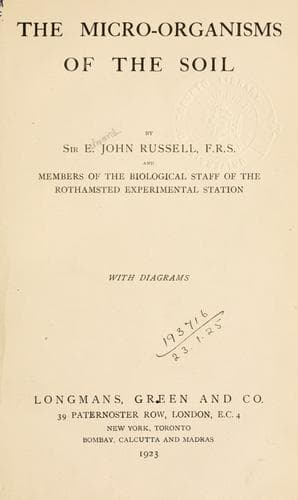
The micro-organisms of the soilRussell, Edward J. (Edward John)
Science
The micro-organisms of the soil
Russell, Edward J. (Edward John)
Soil microbiology
It had long been known that the growth of leguminous crops, unlike that
of others, enriched the ground,[C] and Lawes and Gilbert had shown
that this was due to an increase of soil nitrogen. But no explanation
could be found till Hellriegel and Wilfarth solved the problem.[4] In
studying the nitrogen nutrition of gramineous and leguminous crops,
they discovered that the gramineous plants died in absence of nitrate,
and in its presence made growth which increased regularly with nitrate
supply; while leguminous plants sometimes died and sometimes flourished
in absence of nitrate, and behaved equally erratically with increasing
nitrate supply. When the plants flourished nodules were invariably
present on the roots, but not otherwise. They concluded, therefore,
that the nitrogen nutrition of leguminous plants differed from that
of the gramineæ, and depended on some factor which sometimes came
into their experiments and sometimes did not, and, in any case, was
associated with the nodule. Knowing that the nodules on the roots of
leguminous plants contained bacteria-like bodies, and remembering
Berthelot’s results, they explored the possibility of bacterial
fixation. They sterilised the sand and found that peas invariably
failed to develop nodules and died, but after adding a little garden
soil nodules were found and vigorous growth was obtained.
[C] “Of the leguminous plants the bean best reinvigorates the ground
... because the plant is of loose growth and rots easily, wherefore
the people of Macedonia and Thessaly turn over the ground when it
is in flower” (i.e. dig it into the ground if the soil is poor).
Theophrastus, “Enquiry into Plants,” bk. viii. 2, and bk. ix. I. This
book is of profound interest to agriculturists and botanists. An
excellent translation by Sir Arthur Hort is now available. (Loeb’s
Classical Library.)
Chemical analysis showed considerable fixation of gaseous nitrogen,
which Hellriegel associated with the nodule organism. This has proved
to be correct, and the fixation of nitrogen by bacteria is now a
well-recognised process, the conditions of which are being thoroughly
worked out. Two types of organisms are known--those associated with
leguminous plants, and those living in a free and independent state in
the soil. Of the latter the Clostridium, isolated by Winogradsky, is
anaerobic, and the Azotobacter of Beijerinck is aerobic. The essential
conditions are that a source of energy must be supplied--usually
given as sugar--that the medium must not be acid, and that sufficient
phosphate must be present.
Public-domain text, read in full here on John Shaqi.
Reviews
Reviews
No reviews yet
Be the first to share your thoughts on this work.
Join the Discussion
Join the discussion
Sign in to leave a comment or review.
Sign InorCreate an account