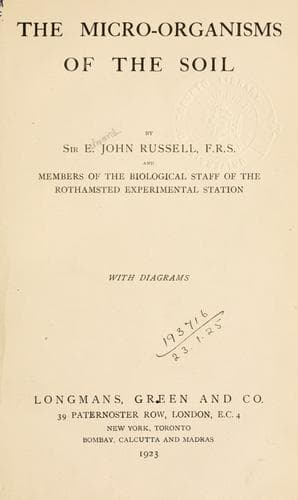
The micro-organisms of the soilRussell, Edward J. (Edward John)
Science
The micro-organisms of the soil
Russell, Edward J. (Edward John)
Soil microbiology
All this brilliant work had been accomplished in the short space of the
ten years 1880 to 1890. The inspiration had in each instance come from
France, and is traceable direct to Pasteur, although coming long after
his own work on bacteriology. It is impossible for us now to realise
the thrill of wonder and astonishment with which students, teachers,
and writers of those days learned that the nutrition of plants, and
therefore the growth of crops and the feeding of themselves, was
largely the result of the activity of bacteria in the dark recesses of
the soil. It is not surprising that the ideas were pushed somewhat too
far, that the soil population was regarded as solely bacterial, and
that important chemical and physical changes were sometimes overlooked.
Gradually there came the inevitable reaction and a somewhat changed
outlook. Continued examination showed the presence in soil of almost
every kind of bacteria for which search was made. Some of them were
almost certainly in the resting condition as spores, and the new
generation of workers had an uneasy feeling that the case for the
overwhelming importance of bacteria in the economy of the soil was
not too well founded. It was shown that the decomposition of nitrogen
compounds to form ammonia would take place without micro-organisms if,
as presumably would happen, the plant enzymes continued to act after
they got into the soil. Even the oxidation of ammonia to nitrate--the
great stronghold of the biological school--was accomplished by chemical
agents. The fixation of nitrogen in soil conditions was beyond the
power of chemists to achieve, and here it was universally agreed that
bacteria were the active agents. And finally, chemists were themselves
bringing into prominence a set of bodies--the colloids--whose
remarkable properties seemed indefinitely expansible, and were in
addition sufficiently incomprehensible to the ordinary student to
attain much of the magnificence of the unknown.
All the time, however, a faithful body of workers was busy exploring
the ground already won, improving the technique, making counts of the
numbers of bacteria in the soil, and trying to measure the amount of
bacterial activity. Much of the value of this work was limited by the
circumstance that the bacteria were regarded as more or less constant
in numbers and activities, so that a single determination was supposed
to characterise the position in a given soil.
Public-domain text, read in full here on John Shaqi.
Reviews
Reviews
No reviews yet
Be the first to share your thoughts on this work.
Join the Discussion
Join the discussion
Sign in to leave a comment or review.
Sign InorCreate an account