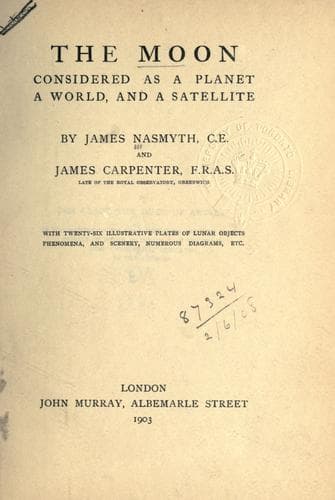
The Moon: considered as a planet, a world, and a satellite.Nasmyth, James
Science
The Moon: considered as a planet, a world, and a satellite.
Nasmyth, James
Moon
At the earlier periods of Herschel’s observations, that illustrious
observer appears to have inclined to the belief that all nebulæ were but
remote clusters of stars, so distant, so faint, and so thickly
agglomerated as to affect the eye only by their combined luminosity, and
at this period of the nebular history it was supposed that increased
telescopic power would resolve them into their component stars. But the
familiarity which Herschel gained with the phases of the multitudinous
nebulæ that passed in review before his eyes, led him ultimately to
adopt the opinion, advanced by previous philosophers, that they were
composed of some vapoury or elementary matter out of which, by the
process of condensation, the heavenly bodies were formed; and this led
him to attempt a classification of the known nebulæ into a cosmical
arrangement, in which, regarding a chaotic mass of vapoury matter as the
primordial state of existence, he arranged them into a series of stages
of progressive development, the individuals of one class being so nearly
allied to those in the next that, to use his own expression, not so much
difference existed between them “as there would be in an annual
description of the human figure were it given from the birth of a child
till he comes to be a man in his prime.” (_Philosophical Transactions,
Vol. CI., pp. 271_, _et seq._)
His category comprises upwards of thirty classes or stages of
progression, the titles of a few of which we insert here to illustrate
the completeness of his scheme.
Class 1. Of extensive diffused nebulosity. (A table of 52
patches of such nebulosity actually observed is given,
some of which extend over an area of five or six square
degrees, and one of which occupies nine square degrees.)
” 6. Of milky nebulosity with condensation.
” 15. Of nebulæ that are of an irregular figure.
” 17. Of round nebulæ.
” 20. Of nebulæ that are gradually brighter in the middle.
” 25. Of nebulæ that have a nucleus.
” 29. Of nebulæ that draw progressively towards a period of
final condensation.
” 30. Of planetary nebulæ.
” 33. Of stellar nebulæ nearly approaching the appearance of
stars.
Public-domain text, read in full here on John Shaqi.
Reviews
Reviews
No reviews yet
Be the first to share your thoughts on this work.
Join the Discussion
Join the discussion
Sign in to leave a comment or review.
Sign InorCreate an account