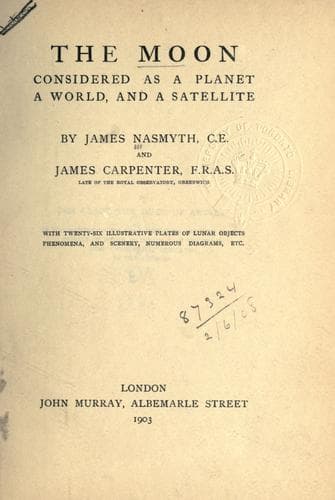
The Moon: considered as a planet, a world, and a satellite. — John Shaqi
The Moon: considered as a planet, a world, and a satellite.Nasmyth, James
Science
The Moon: considered as a planet, a world, and a satellite.
Nasmyth, James
Moon
In a walk through a forest we see trees in every stage of growth, from
the tiny sapling to the giant of the woods, and no doubt can exist in
our minds that the latter has sprung from the former. We cannot at a
passing glance discern the process of development actually going on; to
satisfy ourselves of this, we must record the appearance of some single
tree from time to time through a long series of years. And what a walk
through a forest is to an observer of the growth of a tree, a lifetime
is to the observer of changes in such objects as the nebulæ. The
transition from one state to another of the nebulous development is so
slow that a lifetime is hardly sufficient to detect it. Nor can any
precise evidence of change be obtained by the comparison of drawings or
descriptions of nebulæ at various epochs, with whatever care or skill
such drawings be made, for it will be admitted that no two draughtsmen
will produce each a drawing of the most simple object from the same
point of view, in which every detail in the one will coincide exactly
with every detail in the other. There is abundant evidence of this in
the existing representations of the great nebula in Orion; a comparison
of the drawings that have been lately made of this object, with the most
perfect instruments and by the most skilful of astronomical draughtsmen,
reveals varieties of detail and even of general appearance such as could
hardly be imagined to occur in similar delineations of one and the same
subject; and any one who himself makes a perfectly unbiassed drawing at
the telescope will find upon comparison of it with others that it will
offer many points of difference. The fact is that the drawing of a man,
like his penmanship, is a personal characteristic, peculiar to himself,
and the drawings of two persons cannot be expected to coincide any more
than their handwritings. The appearance of a nebula varies also to a
great extent with the power of the telescope used to observe it and the
conditions under which it is observed; the drawings of nebulæ made with
the inferior telescopes of a century or two centuries ago, the only ones
that, by comparison with those made in modern times, could give
satisfactory evidence of changes of form or detail, are so rude and
imperfect as to be useless for the purpose, and it is reasonable to
suppose that those made in the present day will be similarly useless a
century or two hence. Since then we can obtain no evidence of the
changes we must assume these mysterious objects to be undergoing, _ipso
facto_, by observation of _one nebula_ at _various periods_, we must for
the present accept the _primâ facie_ evidence offered (as in the case of
the trees in a forest) by the observation of _various nebulæ_ at _one
period_.
Public-domain text, read in full here on John Shaqi.
Reviews
Reviews
No reviews yet
Be the first to share your thoughts on this work.
Join the Discussion
Join the discussion
Sign in to leave a comment or review.
Sign InorCreate an account