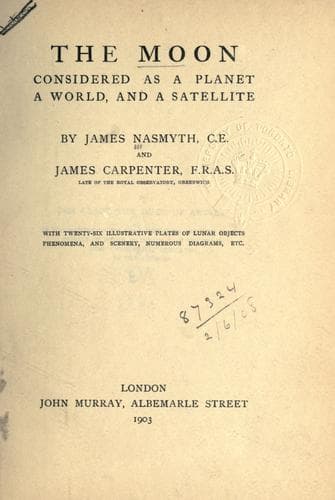
The Moon: considered as a planet, a world, and a satellite.Nasmyth, James
Science
The Moon: considered as a planet, a world, and a satellite.
Nasmyth, James
Moon
Before the telescope revealed the hidden wonders of the skies, and
brought its rich fruits into our garner of knowledge concerning the
nature of the universe, the philosophic minds of some early astronomers,
Kepler and Tycho Brahe to wit, entertained the idea that the sun and the
stars—the suns of distant systems—were formed by the condensation of
celestial vapours into spherical bodies; Kepler basing his opinion on
the phenomena of the sudden shining forth of new stars on the margin of
the Milky Way. But it was when the telescope pierced into the depths of
celestial space, and brought to light the host of those marvellous
objects, the nebulæ, that the strongest evidence was afforded of the
probable validity of these suppositions. The mention of “nebulous stars”
made by the earlier astronomers refers only to clusters of telescopic
stars which the naked eye perceives as small patches of nebulous light;
and it does not appear that even the nebula in Andromeda, although so
plainly discernible as to be often now-a-days mistaken by the
uninitiated for a comet, was known, until it was discovered by means of
a telescope, in 1612, by Simon Marius, who described it as resembling a
candle shining through semi-transparent horn, as in a lantern, and
without any appearance of stars. Forty years after this date Huygens
discovered the splendid nebula in the sword handle of Orion, and in 1665
another was detected by Hevelius. In 1667 Halley (afterwards Astronomer
Royal) discovered a fourth; a fifth was found by Kirsch in 1681, and a
sixth by Halley again in 1714. Half a century after this the labours of
Messier expanded the list of known nebulæ and clusters to 103, a
catalogue of which appeared in the “Connaissance du Temps” (the French
“Nautical Almanac”) for the years 1783-1784. But this branch of
celestial discovery achieved its most brilliant results when the rare
penetration, the indomitable perseverance, and the powerful instruments
of the elder Herschel were brought to bear upon it. In the year 1779
this great astronomer began to search after nebulæ with a seven-inch
reflector, which he subsequently superseded by the great one of forty
feet focus and four feet aperture. In 1786 he published his first
catalogue of 1000 nebulæ; three years later he astonished the learned
world by a second catalogue containing 1000 more, and in 1802 a third
came forth comprising other 500, making 2500 in all! This number has
been so far increased by the labours of more recent astronomers that the
last complete catalogue, that of Sir John Herschel, published a few
years ago, contains the places of 5063 nebulæ and clusters.
Public-domain text, read in full here on John Shaqi.
Reviews
Reviews
No reviews yet
Be the first to share your thoughts on this work.
Join the Discussion
Join the discussion
Sign in to leave a comment or review.
Sign InorCreate an account