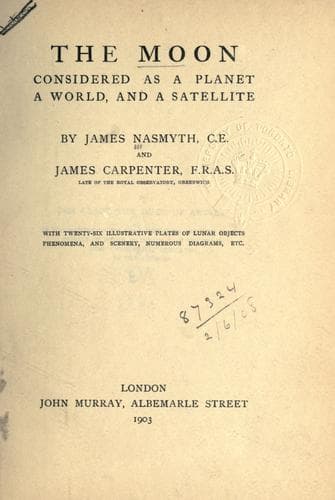
The Moon: considered as a planet, a world, and a satellite.Nasmyth, James
Science
The Moon: considered as a planet, a world, and a satellite.
Nasmyth, James
Moon
In the preceding Chapter we endeavoured to show how the action of
gravitation upon the particles of diffused primordial matter would
result in the formation, by condensation and aggregation, of a spherical
planetary body. We have now to consider another result of the
gravitating action, and for this we must call to our aid a branch of
scientific enquiry and investigation unrecognized as such at the period
of Laplace’s speculations, and which has been developed almost entirely
within the past quarter of a century.
The “great philosophical doctrine of the present era of science,” as the
subject about to engage our attention has been justly termed, bears the
title of the “Conservation of Force,” or—as some ambiguity is likely to
attend the definition of the term “Force”—the “Conservation of Energy.”
The basis of the doctrine is the broad and comprehensive natural law
which teaches us that the quantity of force comprised by the universe,
like the quantity of matter contained in it, is a fixed and invariable
amount, which can be neither added to nor taken from, but which is for
ever undergoing change and transformation from one form to another. That
we cannot create force ought to be as obvious a fact as that we cannot
create matter; and what we cannot create we cannot destroy. As in the
universe we see no new matter created, but the same matter constantly
disappearing from one form and reappearing in another, so we can find no
new force ever coming into action—no description of force that is not to
be referred to some previous manner of existence.
Without entering upon a metaphysical discussion of the term “force,” it
will be sufficient for our purpose to consider it as something which
produces or resists motion, and hence we may argue that the ultimate
effect of force is motion. The force of gravity on the earth results in
the motion or tendency of all bodies towards its centre, and, similarly,
the action of gravitation upon the atoms or particles of a primeval
planet resulted in the motion of those particles towards each other. We
cannot conceive force otherwise than by its effects, or the motion it
produces.
Public-domain text, read in full here on John Shaqi.
Reviews
Reviews
No reviews yet
Be the first to share your thoughts on this work.
Join the Discussion
Join the discussion
Sign in to leave a comment or review.
Sign InorCreate an account