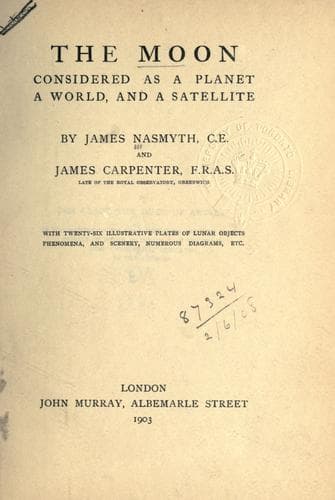
The Moon: considered as a planet, a world, and a satellite.Nasmyth, James
Science
The Moon: considered as a planet, a world, and a satellite.
Nasmyth, James
Moon
And force we are taught is indestructible; therefore motion must be
indestructible also. But when a falling body strikes the earth, or a
gunshot strikes its target, or a hammer delivers a blow upon an anvil,
or a brake is pressed against a rotating wheel, motion is arrested, and
it would seem natural to infer that it is destroyed. But if we say it is
indestructible, what becomes of it? The philosophical answer to the
question is this—that the motion of the mass becomes transferred to the
particles or molecules composing it, and transformed to molecular
motion, and this molecular motion manifests itself to us as heat. The
particles or atoms of matter are held together by cohesion, or, in other
words, by the action of molecular attraction. When heat is applied to
these particles, motion is set up among them, they are set in vibration,
and thus, requiring and making wider room, they urge each other apart,
and the well-known _expansion by heat_ is the result. If the heat be
further continued a more violent molecular motion ensues, every increase
of heat tending to urge the atoms further apart, till at length they
overcome their cohesive attraction and move about each other, and a
_liquid or molten condition_ results. If the heat be still further
increased, the atoms break away from their cohesive fetters altogether
and leap off the mass in the form of vapour, and the matter thus assumes
the _gaseous or vaporous form_. Thus we see that the phenomena of heat
are phenomena of motion, and of motion only.
Public-domain text, read in full here on John Shaqi.
Reviews
Reviews
No reviews yet
Be the first to share your thoughts on this work.
Join the Discussion
Join the discussion
Sign in to leave a comment or review.
Sign InorCreate an account