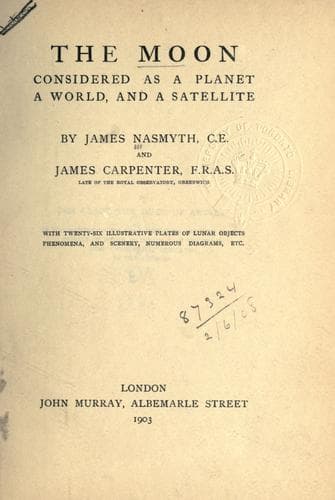
The Moon: considered as a planet, a world, and a satellite.Nasmyth, James
Science
The Moon: considered as a planet, a world, and a satellite.
Nasmyth, James
Moon
This mutual relation between heat and work presented itself as an embryo
idea to the minds of several of the earlier philosophers, by whom it was
maintained in opposition to the _material theory_ which held heat to be
a kind of matter or subtle fluid stored up in the inter-atomic spaces of
all bodies, capable of being separated and procured from them by rubbing
them together, but not generated thereby. Bacon, in his “Novum Organum,”
says that “heat itself, its essence and quiddity, is motion and nothing
else.” Locke defines heat as “a very brisk agitation of the insensible
parts of an object, which produces in us that sensation from whence we
denominate the object hot; so what in our sensation is _heat_, in the
object is nothing but _motion_.” Descartes and his followers upheld a
similar opinion. Richard Boyle, two hundred years ago, actually wrote a
treatise entitled “The Mechanical Theory of Heat and Cold,” and the
ingenious Count Rumford made some highly interesting and significant
experiments on the subject, which are described in a paper read before
the Royal Society in 1798, entitled “An Inquiry concerning the Source of
Heat excited by Friction.” But the conceptions of these authors remained
isolated and unfruitful for more than a century, and might have passed,
meantime, into the oblivion of barren speculation, but for the impulse
which this branch of inquiry has lately received. Now, however, they
stand forth as notable instances of truth trying to force itself into
recognition while yet men’s minds were unprepared or disinclined to
receive it. The key to the beautiful mechanical theory of heat was found
by these searching minds, but the unclasping of the lock that should
disclose its beauty and value was reserved for the philosophers of the
present age.
Simultaneously and independently, and without even the knowledge of each
other, three men, far removed from probable intercourse, conceived the
same ideas and worked out nearly similar results concerning the
mechanical theory of heat. Seeing that motion was convertible into heat,
and heat into motion, it became of the utmost importance to determine
the exact relation that existed between the two elements. The first who
raised the idea to philosophic clearness was Dr. Julius Robert Mayer, a
physician of Heilbronn in Germany. In certain observations connected
with his medical practice it occurred to him that there must be a
necessary equivalent between work and heat, a necessary numerical
relation between them. “The variations of the difference of colour of
arterial and venous blood directed his attention to the theory of
respiration. He soon saw in the respiration of animals the origin of
their motive powers, and the comparison of animals to thermic machines
afterwards suggested to him the important principle with which his name
will remain for ever connected.”
Public-domain text, read in full here on John Shaqi.
Reviews
Reviews
No reviews yet
Be the first to share your thoughts on this work.
Join the Discussion
Join the discussion
Sign in to leave a comment or review.
Sign InorCreate an account