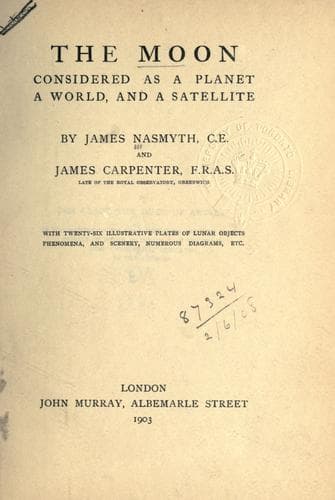
The Moon: considered as a planet, a world, and a satellite.Nasmyth, James
Science
The Moon: considered as a planet, a world, and a satellite.
Nasmyth, James
Moon
Reverting, now, to the mass of the moon: we must bear in mind that the
mass or weight of a planetary body determines the weight of all objects
on its surface. What we call a pound on the earth, would not be a pound
on the moon; for the following reason:—When we say that such and such an
object weighs so much, we really mean that it is attracted towards the
earth with a certain force depending upon its own weight. This
attraction we call gravity; and the falling of a weight to the earth is
an example of the action of the law of universal gravitation. The earth
and the weight fall together—or are held together if the weight is in
contact with the earth—with a force which depends directly upon the mass
of the two, and upon the distance between them. Newton proved that the
attraction of a sphere upon external objects is precisely as if the
whole of its matter were contained at its centre. So that the attractive
force of the earth upon a ton weight at its surface, is the attraction
which 5842 trillions of tons exert upon one ton situated 3956 miles (the
radius of the earth) distant. If the weight of the earth were only half
the above quantity, it is clear that the attraction would be only half
what it is; and hence the ton weight, being pulled by only half the
force, would only be equal to half a ton; that is to say, only half as
much muscular force (or any other force but gravity) would be required
to lift it. It is plain, therefore, that what weighs a pound on the
earth could not weigh a pound on the moon, which is only 1/80 of the
weight of the earth. What, then, is the relation between a pound on the
earth and the same mass of matter on the moon? It would seem, since the
moon’s mass is 1/80 of the earth, that the pound transported to the moon
ought to weigh the eightieth part of a pound there; and so it would if
the distance from the centre of the moon to its surface were the same as
the distance of the centre of the earth from its surface. But the radius
of the moon is only 1/3·665 that of the earth; and the force of gravity
varies _inversely as the square of the distance_ between the centres of
the gravitating masses. So that the attraction by the moon of a body at
its surface, as compared with that of the earth, is 1/80 multiplied by
the square of 1/3·665; and this, worked out, is equal to 1/6. The force
of gravity upon the moon is, therefore, 1/6 of that on the earth; and
hence a pound upon the earth would be little more than 2½ ounces on the
moon; and it follows as a consequence that any force, such as muscular
exertion, or the energy of chemical, plutonic or explosive forces, would
be six times more effective upon the moon than upon the earth. A man who
could jump six feet from the earth, could with the same muscular effort
jump thirty-six feet from the moon; the explosive energy that would
project a body a mile above the earth would project a like body six
miles above the surface of the moon.
Public-domain text, read in full here on John Shaqi.
Reviews
Reviews
No reviews yet
Be the first to share your thoughts on this work.
Join the Discussion
Join the discussion
Sign in to leave a comment or review.
Sign InorCreate an account