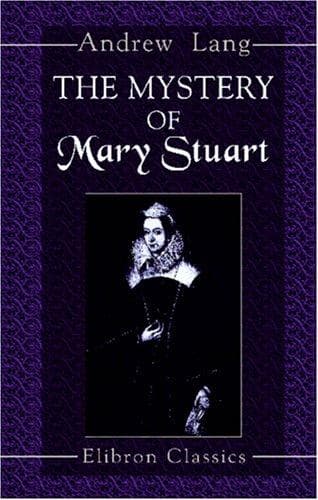
Mary, Queen of Scots, 1542-1587; Queens -- Scotland -- Biography; Scotland -- History -- Mary Stuart, 1542-1567
Her costumes, when she would be queenly, have left their mark on the
memory of men: the ruff from which rose the snowy neck; the brocaded
bodice, with puffed and jewelled sleeves and stomacher; the diamonds,
gifts of Henri II. or of Diane; the rich pearls that became the spoil of
Elizabeth; the brooches enamelled with sacred scenes, or scenes from
fable. Many of her jewels--the ruby tortoise given by Riccio; the enamel
of the mouse and the ensnared lioness, passed by Lethington as a token
into her dungeon of Loch Leven; the diamonds bequeathed by her to one whom
she might not name; the red enamelled wedding-ring, the gift of Darnley;
the diamond worn in her bosom, the betrothal present of Norfolk--are, to
our fancy, like the fabled star-ruby of Helen of Troy, that dripped with
blood-gouts which vanished as they fell. Riccio, Darnley, Lethington,
Norfolk, the donors of these jewels, they were all to die for her, as
Bothwell, too, was to perish, the giver of the diamond carried by Paris,
the recipient of the black betrothal ring enamelled with bones and tears.
‘Her feet go down to death,’ her feet that were so light in the dance,
‘her steps take hold on hell.... Her lips drop as an honeycomb, and her
mouth is smoother than oil. But her end is bitter as wormwood, sharp as a
two-edged sword.’ The lips that dropped as honeycomb, the laughing mouth,
could wildly threaten, and vainly rage or beseech, when she was entrapped
at Carberry; or could waken pity in the sternest Puritan when, half-clad,
her bosom bare, her loose hair flowing, she wailed from her window to the
crowd of hostile Edinburgh.
She was of a high impatient spirit: we seem to recognise her in an
anecdote told by the Black Laird of Ormistoun, one of Darnley’s murderers,
in prison before his execution. He had been warned by his brother, in a
letter, that he was suspected of the crime, and should ‘get some good way
to purge himself.’ He showed the letter to Bothwell, who read it, and gave
it to Mary. She glanced at it, handed it to Huntly, ‘and thereafter turnit
unto me, and turnit her back, and gave _ane thring_ with her shoulder, and
passit away, and spake nothing to me.’ But that ‘thring’ spoke much of
Mary’s mood, unrepentant, contemptuous, defiant.
Public-domain text, read in full here on John Shaqi.
Reviews
Reviews
No reviews yet
Be the first to share your thoughts on this work.
Join the Discussion
Join the discussion
Sign in to leave a comment or review.
Sign InorCreate an account