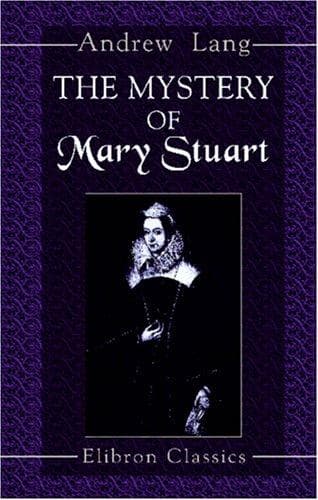
Mary, Queen of Scots, 1542-1587; Queens -- Scotland -- Biography; Scotland -- History -- Mary Stuart, 1542-1567
One strange feature of the age we must not forget: the universal belief in
sorcery. Mary and Moray (she declares) both believed that Ruthven had
given her a ring of baneful magical properties. Foes and friends alike
alleged that Bothwell had bewitched Mary ‘by unleasom means,’ philtres,
‘sweet waters,’ magic. The preachers, when Mary fled, urged Moray to burn
witches, and the cliffs of St. Andrews flared with the flames wherein they
perished. The Lyon King at Arms, as has been said, died by fire,
apparently for confessed dealings with a wizard, who foretold the events
of the year, and for treasure hunting with the divining rod. A Napier of
Merchistoun did foretell Mary’s escape (according to Nau); this man,
_ayant réputation de grand magicien_, may have been the soothsayer: his
son sought for hidden treasure by divination. Buchanan tells how a dying
gentleman beheld Darnley’s fate in a clairvoyant vision: and how a dim
shapeless thing smote and awoke, successively, four Atholl men in
Edinburgh, on the night of the crime of Kirk o’ Field. Old rhyming
prophecies were circulated and believed. Knox himself was credited with
winning his sixteen-year-old bride by witchcraft, as Bothwell won Mary.
Men listened to his reports of his own ‘premonitions.’
When Huntly, one of the band for Darnley’s murder, died, his death was
strange. He had hunted, and taken three hares and a fox, after dinner he
played football, fell into a fit, and expired, crying ‘never a word save
one, looking up broad with his eyes, and that word was this, “Look, Look,
Look!”’ Unlike the dying murderer of Riccio, Ruthven, he perhaps did not
behold the Angel Choir. His coffers were locked up in a chamber, with
candles burning. Next day a rough fellow, banished by Lochinvar, and
received by Huntly, fell into unconsciousness for twenty-four hours, and
on waking, cried ‘_Cauld, cauld, cauld!_’ John Hamilton, opening one of
the dead Earl’s coffers, fell down with the same exclamation. Men carried
him away, and, returning, found a third man fallen senseless on the
coffer. ‘All wrought as the Earl of Huntly wrought in the death thraw.’
The chamber was haunted by strange sounds: the word went about that the
Earl was rising again. Says Knox’s secretary, Bannatyne, who tells this
tale, ‘I maun praise the Lord my God, and bless his holy name for ever,
when I behold the five that was in the conspiracy, not only of the King’s
[Darnley’s] and the second Regent’s murder, but also of the first Regent’s
murder. Four is past with small provision, to wit, Lethington, Argyll,
Bothwell, and last of all Huntly. I hope in God the fifth [Morton] shall
die more perfectly, and declare his life’s deeds with his own mouth,
making his repentance at the gallows foot.’ Part of his life’s deeds
Morton did declare on his dying day.
Public-domain text, read in full here on John Shaqi.
Reviews
Reviews
No reviews yet
Be the first to share your thoughts on this work.
Join the Discussion
Join the discussion
Sign in to leave a comment or review.
Sign InorCreate an account