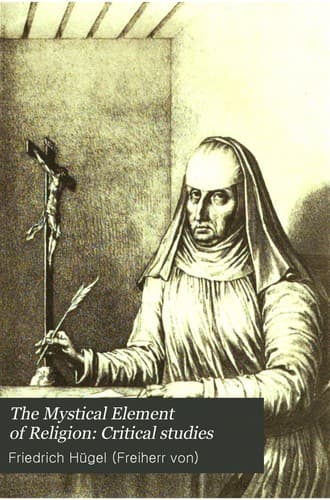
The Mystical Element of Religion, as studied in Saint Catherine of Genoa and her friends, Volume 2 (of 2)Hügel, Friedrich, Freiherr von
Religion
The Mystical Element of Religion, as studied in Saint Catherine of Genoa and her friends, Volume 2 (of 2)
Hügel, Friedrich, Freiherr von
Catherine, of Genoa, Saint, 1447-1510
I take the accounts of both these remarkable peculiarities to be
substantially accurate, since, if the first condition had not obtained,
we should have found her practising more or less frequent Confession,
as we find her doing in the first and third, but not in this period;
and if the second condition had not existed, we should have had, for
this period also, some such vivid account of painful scruples arising
from the impression of actually present unfaithfulnesses, such as has
been preserved for her last years. And indeed, as soon as we have
vividly conceived a state in which a soul (by a wise utilization of the
quite exceptional successiveness and simplification to which it has
been, in great part, driven by its temperamental requirements, and by
a constant heroic watchfulness) has managed to exclude from its life,
during a long series of years, all fully deliberate resistances to, or
lapses from, its contemporaneous better insight: one sees at once that
a consciousness of faultiness could come to her only at those moments
when, one state and level giving place to another, she could, for the
moment, see the former habits and their implicit defects in the clear
light of their contrast to her new, deeper insights and dispositions.
Now it is evident that here again we have in part (in the curious
quasi-fixity of each state, and then the sudden replacement of it
by another) something which, taken alone, is simply psychically
peculiar and spiritually indifferent. The persistent sense of gradual
or of rapid change in the midst of a certain continuity and indeed
abidingness, characteristic of the average moments of the average soul,
is, taken in itself, more true to life and to the normal reaction of
the human mind, and not less capable of spiritual utilization, than is
Catherine’s peculiarity. Her heroic utilization of her special psychic
life for purposes of self-fighting, and the degree in which, as we
shall find in a later chapter, she succeeded in moulding this life into
a shape representative of certain great spiritual truths: these things
it is which constitute here the spiritually significant element.
Public-domain text, read in full here on John Shaqi.
Reviews
Reviews
No reviews yet
Be the first to share your thoughts on this work.
Join the Discussion
Join the discussion
Sign in to leave a comment or review.
Sign InorCreate an account