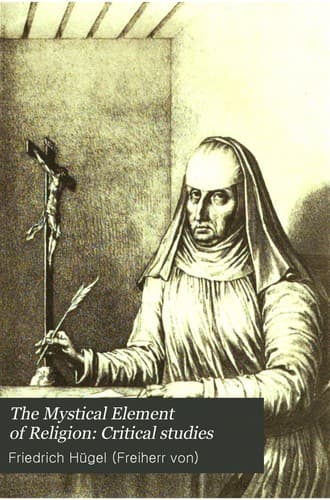
The Mystical Element of Religion, as studied in Saint Catherine of Genoa and her friends, Volume 2 (of 2)Hügel, Friedrich, Freiherr von
Religion
The Mystical Element of Religion, as studied in Saint Catherine of Genoa and her friends, Volume 2 (of 2)
Hügel, Friedrich, Freiherr von
Catherine, of Genoa, Saint, 1447-1510
The mystical and contemplative element in the religious life, and the
group of saints amongst whom this element is predominant, no doubt give
us a still larger amount of what, again taking the matter phenomenally
and not ultimately, is once more mono-ideism and auto-suggestion,
and entails a correspondingly larger amount of psycho-physical
impressionableness and reaction utilized by the mind. But here also,
from the simplest forms of the “prayer of quiet” to absorptions of an
approximately ecstatic type, we have something which, though different
in kind and value, is yet no more abnormal than are the highest flights
and absorptions of the Philosopher, the Musician, and the Poet. And
yet, in such cases as Kant and Beethoven, a classifier of humanity
according to its psycho-physical phenomena alone would put these great
discoverers and creators, without hesitation, amongst hopeless and
useless hypochondriacs. Yet here again the truth of their ideas and the
work of their lives have to be measured by quite other things than by
this their neural concomitance and cost.
3. _Ecstatics possess a peculiar psycho-physical organization._
The downright ecstatics and hearers of voices and seers of visions
have all, wherever we are able to trace their temperamental and neural
constitution and history, possessed and developed a definitely peculiar
psycho-physical organization. We have traced it in Catherine and
indicated it in St. Teresa. We find it again in St. Maria Magdalena
dei Pazzi and in St. Marguerite Marie Alacocque, in modern times,
and in St. Catherine of Siena and St. Francis of Assisi in mediaeval
times. For early Christian times we are too ignorant as regards the
psycho-physical organization of St. Ignatius of Antioch, Hermas,
and St. Cyprian, to be able to establish a connection between their
temperamental endowments and their hearing of voices and seeing of
visions--in the last two cases we get much that looks like more or less
of a mere conventional literary device.[39]
We are, however, in a fair position for judging, in the typical and
thoroughly original case of St. Paul. In 2 Cor. xiii, 7, 8, after
speaking of the abundant revelations accorded to him, he adds that
“lest I be lifted up, a thorn” (literally, a stake) “in the flesh was
given to me, an Angel of Satan to buffet me.” And though “I thrice
besought the Lord that it might depart from me, the Lord answered
me, ‘My grace is sufficient for thee; for grace is perfected in
infirmity.’” And he was consequently determined “rather” to “glory in
his infirmities, so that the power of Christ may dwell within” him.
And in Gal. iv, 14, 15, written about the same time, he reminds his
readers how he had “preached to them through the infirmity of the
flesh,” commending them because they “did not despise nor loathe their
temptation in his flesh” (this is no doubt the correct reading), “but
had received him as an Angel of God, as Christ Jesus.”
Public-domain text, read in full here on John Shaqi.
Reviews
Reviews
No reviews yet
Be the first to share your thoughts on this work.
Join the Discussion
Join the discussion
Sign in to leave a comment or review.
Sign InorCreate an account