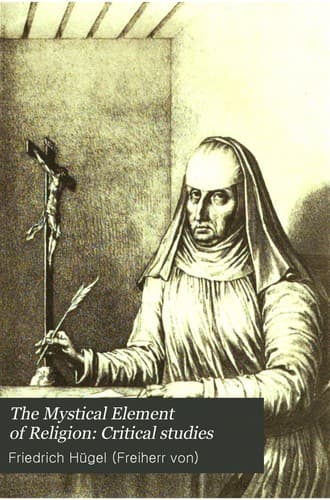
The Mystical Element of Religion, as studied in Saint Catherine of Genoa and her friends, Volume 2 (of 2)Hügel, Friedrich, Freiherr von
Religion
The Mystical Element of Religion, as studied in Saint Catherine of Genoa and her friends, Volume 2 (of 2)
Hügel, Friedrich, Freiherr von
Catherine, of Genoa, Saint, 1447-1510
Thus when we read the views of perhaps all her educated attendants:
“this condition, in which her body remained alive without food or
medicine, was a supernatural thing”; “her state was clearly understood
to be supernatural when, in so short a time, so great a change was
seen”; and “she became yellow all over,--a manifest sign that her
humanity was being entirely consumed in the fire of divine love”:[1]
we feel indeed that we can no more follow. And when we read, as part
of one of the late additions, the worthless legends gathered from, or
occasioned by, the uneducated Argentina: “in proof that she bore the
stigmata within her,--on putting her hands in a cup of cold water, the
latter became so boiling hot that it greatly heated the very saucer
beneath it”:[2] we are necessarily disgusted. And when, worst of all,
she is made, by a demonstrable, probably double misinterpretation of an
externally similar action, to burn her bare arm with a live charcoal
or lighted candle, with intent to see which fire, this external one or
that interior one of the divine love, were the greater:[3] we can, even
if we have the good fortune of being able, by means of the critical
analysis of the sources, to put this absurd story to the discredit of
her eulogists, but feel the pathos of such well-meant perversity, which
took so sure a way for rendering ridiculous one who, take her all in
all, is so truly great.[4]
3. _Slow growth of Neurology._
We should, of course, be very patient in such matters: for
psycho-physical knowledge was, as yet, in its very infancy, witness
the all-important fact that the nerves were, in our modern sense of
the term, still as unknown as they were to the whole of Graeco-Roman
antiquity, with which “neuron” and “nervus” ever meant “muscle” or
“ligament” and, derivatively, “energy,” but never consciously what
they now mean in the strict medical sense. Thus the _Vita_ (1551)
writes: “There remained no member or muscle (nervo) of her body that
was not tormented by fire within it”; “one rib was separated from
the others, with great pains in the ligaments (_nervi_) and bones”;
and “all her body was excruciated and her muscles (_nervi_) were
tormented”:[5] where, in the first and last case, visible muscular
convulsive movements are clearly meant. St. Teresa, in her own _Life_
(1561 or 1562), writes: “Nervous pains, according to the physicians,
are intolerable; and all my nerves were shrunk”; and “if the rapture
lasts, all the nerves are made to feel it.”[6] Even Fénelon (died
1715) can still write of the human body: “The bones sustain the flesh
which envelops them; the nerves” (ligaments, minor muscles) “which
are stretched along them, constitute all their strength; and the
muscles, by inflation and elongation at the points where the nerves
are intertwined with them, produce the most precise and regular
movements.”[7] Here the soul acts directly upon the muscles, and,
through these and their dependent ligaments, upon the bones and the
flesh.
Public-domain text, read in full here on John Shaqi.
Reviews
Reviews
No reviews yet
Be the first to share your thoughts on this work.
Join the Discussion
Join the discussion
Sign in to leave a comment or review.
Sign InorCreate an account