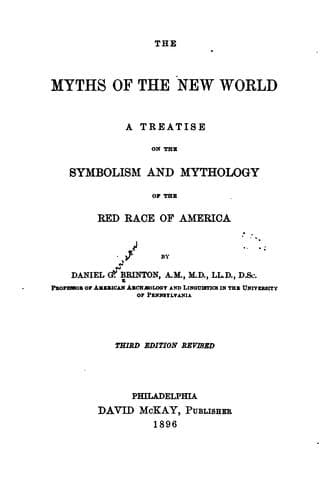
The Myths of the New World: A Treatise on the Symbolism and Mythology of the Red Race of AmericaBrinton, Daniel G. (Daniel Garrison)
Religion
The Myths of the New World: A Treatise on the Symbolism and Mythology of the Red Race of America
Brinton, Daniel G. (Daniel Garrison)
Indian mythology; Indians -- Folklore
These natural features of the continent, compared with the actual
distribution of languages, offer our only guides in forming an opinion
as to the migrations of these various families in ancient times. Their
traditions, take even the most cultivated, are confused, contradictory,
and in great part manifestly fabulous. To construct from them by means
of daring combinations and forced interpretations a connected account of
the race during the centuries preceding Columbus were with the aid of a
vivid fancy an easy matter, but would be quite unworthy the name of
history. The most that can be said with certainty is that the general
course of migrations in both Americas was from the high latitudes toward
the tropics, and from the great western chain of mountains toward the
east. No reasonable doubt exists but that the Athapascas, Algonkins,
Iroquois, Apalachians, and Aztecs all migrated from the north and west
to the regions they occupied. In South America, curiously enough, the
direction is reversed. If the Caribs belong to the Tupi-Guaranay stem,
and if the Quichuas belong to the Aymaras, as there is strong
likelihood,[34-1] then nine-tenths of the population of that vast
continent wandered forth from the steppes and valleys at the head waters
of the Rio de la Plata toward the Gulf of Mexico, where they came in
collision with that other wave of migration surging down from high
northern latitudes. For the banks of the river Paraguay and the steppes
of the Bolivian Cordilleras are unquestionably the earliest traditional
homes of both Tupis and Aymaras.
These movements took place not in large bodies under the stimulus of a
settled purpose, but step by step, family by family, as the older
hunting grounds became too thickly peopled. This fact hints unmistakably
at the gray antiquity of the race. It were idle even to guess how great
this must be, but it is possible to set limits to it in both directions.
On the one hand, not a tittle of evidence is on record to carry the age
of man in America beyond the present geological epoch. Dr. Lund examined
in Brazil more than eight hundred caverns, out of which number only six
contained human bones, and of these six only one had with the human
bones those of animals now extinct. Even in that instance the original
stratification had been disturbed, and probably the bones had been
interred there.[35-1] This is strong negative evidence. So in every
other example where an unbiased and competent geologist has made the
examination, the alleged discoveries of human remains in the older
strata have proved erroneous.
Public-domain text, read in full here on John Shaqi.
Reviews
Reviews
No reviews yet
Be the first to share your thoughts on this work.
Join the Discussion
Join the discussion
Sign in to leave a comment or review.
Sign InorCreate an account