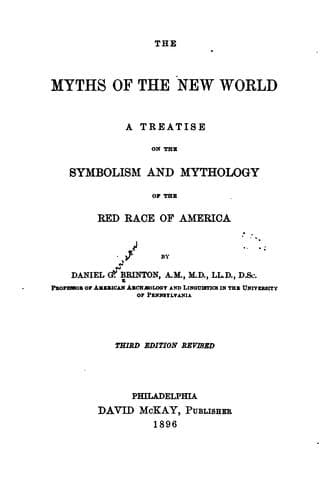
The Myths of the New World: A Treatise on the Symbolism and Mythology of the Red Race of AmericaBrinton, Daniel G. (Daniel Garrison)
Religion
The Myths of the New World: A Treatise on the Symbolism and Mythology of the Red Race of America
Brinton, Daniel G. (Daniel Garrison)
Indian mythology; Indians -- Folklore
The cranial forms of the American aborigines have by some been supposed
to present anomalies distinguishing their race from all others, and even
its chief families from one another. This, too, falls to the ground
before a rigid analysis. The last word of craniology, which at one time
promised to revolutionize ethnology and even history, is that no one form
of the skull is peculiar to the natives of the New World; that in the
same linguistic family one glides into another by imperceptible degrees;
and that there is as much diversity, and the same diversity among them in
this respect as among the races of the Old Continent.[35-2] Peculiarities
of structure, though they may pass as general truths, offer no firm
foundation whereon to construct a scientific ethnology. Anatomy shows
nothing unique in the Indian, nothing demanding for its development any
special antiquity, still less an original diversity of type.
On the other hand, the remains of primeval art and the impress he made
upon nature bespeak for man a residence in the New World coeval with the
most distant events of history. By remains of art I do not so much refer
to those desolate palaces which crumble forgotten in the gloom of
tropical woods, nor even the enormous earthworks of the Mississippi
valley covered with the mould of generations of forest trees, but rather
to the humbler and less deceptive relics of his kitchens and his hunts.
On the Atlantic coast one often sees the refuse of Indian villages,
where generation after generation have passed their summers in fishing,
and left the bones, shells, and charcoal as their only epitaph. How many
such summers would it require for one or two hundred people to thus
gradually accumulate a mound of offal eight or ten feet high and a
hundred yards across, as is common enough? How many generations to heap
up that at the mouth of the Altamaha River, examined and pronounced
exclusively of this origin by Sir Charles Lyell,[36-1] which is about
this height, and covers ten acres of ground? Those who, like myself,
have tramped over many a ploughed field in search of arrow-heads must
have sometimes been amazed at the numbers which are sown over the face
of our country, betokening a most prolonged possession of the soil by
their makers. For a hunting population is always sparse, and the
collector finds only those arrow-heads which lie upon the surface.
Public-domain text, read in full here on John Shaqi.
Reviews
Reviews
No reviews yet
Be the first to share your thoughts on this work.
Join the Discussion
Join the discussion
Sign in to leave a comment or review.
Sign InorCreate an account