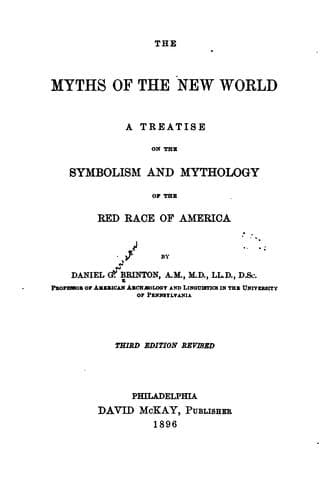
The Myths of the New World: A Treatise on the Symbolism and Mythology of the Red Race of AmericaBrinton, Daniel G. (Daniel Garrison)
Religion
The Myths of the New World: A Treatise on the Symbolism and Mythology of the Red Race of America
Brinton, Daniel G. (Daniel Garrison)
Indian mythology; Indians -- Folklore
Still more forcibly does nature herself bear witness to this antiquity
of possession. Botanists declare that a very lengthy course of
cultivation is required so to alter the form of a plant that it can no
longer be identified with the wild species; and still more protracted
must be the artificial propagation for it to lose its power of
independent life, and to rely wholly on man to preserve it from
extinction. Now this is precisely the condition of the maize, tobacco,
cotton, quinoa, and mandioca plants, and of that species of palm called
by botanists the _Gulielma speciosa_; all have been cultivated from
immemorial time by the aborigines of America, and, except cotton, by no
other race; all no longer are to be identified with any known wild
species; several are sure to perish unless fostered by human care.[37-1]
What numberless ages does this suggest? How many centuries elapsed ere
man thought of cultivating Indian corn? How many more ere it had spread
over nearly a hundred degrees of latitude, and lost all semblance to its
original form? Who has the temerity to answer these questions? The
judicious thinker will perceive in them satisfactory reasons for
dropping once for all the vexed inquiry, "how America was peopled," and
will smile at its imaginary solutions, whether they suggest Jews,
Japanese, or, as the latest theory is, Egyptians.
While these and other considerations testify forcibly to that isolation
I have already mentioned, they are almost equally positive for an
extensive intercourse in very distant ages between the great families of
the race, and for a prevalent unity of mental type, or perhaps they hint
at a still visible oneness of descent. In their stage of culture, the
maize, cotton, and tobacco could hardly have spread so widely by
commerce alone. Then there are verbal similarities running through wide
families of languages which, in the words of Professor Buschmann, are
"calculated to fill us with bewildering amazement,"[38-1] some of which
will hereafter be pointed out; and lastly, passing to the psychological
constitution of the race, we may quote the words of a sharp-sighted
naturalist, whose monograph on one of its tribes is unsurpassed for
profound reflections: "Not only do all the primitive inhabitants of
America stand on one scale of related culture, but that mental condition
of all in which humanity chiefly mirrors itself, to wit, their religious
and moral consciousness, this source of all other inner and outer
conditions, is one with all, however diverse the natural influences
under which they live."[38-2]
Public-domain text, read in full here on John Shaqi.
Reviews
Reviews
No reviews yet
Be the first to share your thoughts on this work.
Join the Discussion
Join the discussion
Sign in to leave a comment or review.
Sign InorCreate an account