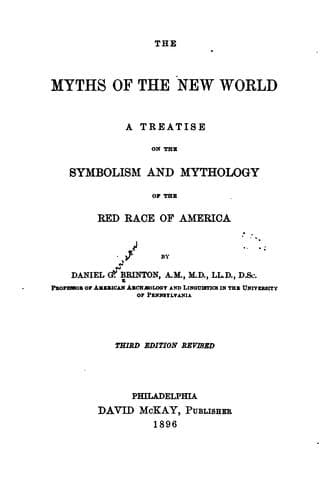
The Myths of the New World: A Treatise on the Symbolism and Mythology of the Red Race of America — John Shaqi
The Myths of the New World: A Treatise on the Symbolism and Mythology of the Red Race of AmericaBrinton, Daniel G. (Daniel Garrison)
Religion
The Myths of the New World: A Treatise on the Symbolism and Mythology of the Red Race of America
Brinton, Daniel G. (Daniel Garrison)
Indian mythology; Indians -- Folklore
Penetrated with the truth of these views, all artificial divisions into
tropical or temperate, civilized or barbarous, will in the present work,
so far as possible, be avoided, and the race will be studied as a unit,
its religion as the development of ideas common to all its members, and
its myths as the garb thrown around these ideas by imaginations more or
less fertile, but seeking everywhere to embody the same notions.
BIBLIOGRAPHICAL NOTE.
As the subject of American mythology is a new one to most readers,
and as in its discussion everything depends on a careful selection
of authorities, it is well at the outset to review very briefly
what has already been written upon it, and to assign the relative
amount of weight that in the following pages will be given to the
works most frequently quoted. The conclusions I have arrived at are
so different from those who have previously touched upon the topic
that such a step seems doubly advisable.
The first who undertook a philosophical survey of American
religions was Dr. Samuel Farmer Jarvis, in 1819 (A Discourse on the
Religion of the Indian Tribes of North America, Collections of the
New York Historical Society, vol. iii., New York, 1821). He
confined himself to the tribes north of Mexico, a difficult portion
of the field, and at that time not very well known. The notion of a
state of primitive civilization prevented Dr. Jarvis from forming
any correct estimate of the native religions, as it led him to look
upon them as deteriorations from purer faiths instead of
developments. Thus he speaks of them as having "departed less than
among any other nation from the form of primeval truth," and also
mentions their "wonderful uniformity" (pp. 219, 221).
Public-domain text, read in full here on John Shaqi.
Reviews
Reviews
No reviews yet
Be the first to share your thoughts on this work.
Join the Discussion
Join the discussion
Sign in to leave a comment or review.
Sign InorCreate an account