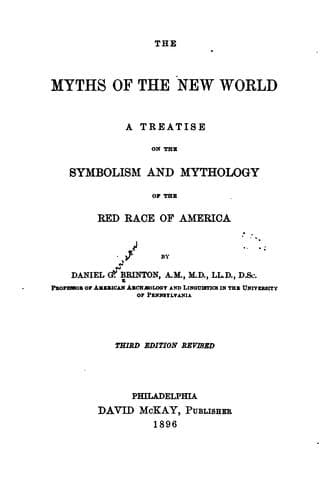
The Myths of the New World: A Treatise on the Symbolism and Mythology of the Red Race of America — John Shaqi
The Myths of the New World: A Treatise on the Symbolism and Mythology of the Red Race of AmericaBrinton, Daniel G. (Daniel Garrison)
Religion
The Myths of the New World: A Treatise on the Symbolism and Mythology of the Red Race of America
Brinton, Daniel G. (Daniel Garrison)
Indian mythology; Indians -- Folklore
The well-known American ethnologist, Mr. E. G. Squier, has also
published a work on the subject, of wider scope than its title
indicates (The Serpent Symbol in America, New York, 1851). Though
written in a much more liberal spirit than the preceding, it is
wholly in the interests of one school of mythology, and it the
rather shallow physical one, so fashionable in Europe half a
century ago. Thus, with a sweeping generalization, he says, "The
religions or superstitions of the American nations, however
different they may appear to the superficial glance, are
rudimentally the same, and are only modifications of that primitive
system which under its physical aspect has been denominated Sun or
Fire worship" (p. 111). With this he combines the favorite and (may
I add?) characteristic French doctrine, that the chief topic of
mythology is the adoration of the generative power, and to rescue
such views from their materializing tendencies, imagines to
counterbalance them a clear, universal monotheism. "We claim to
have shown," he says (p. 154), "that the grand conception of a
Supreme Unity and the doctrine of the reciprocal principles existed
in America in a well defined and clearly recognized form;" and
elsewhere that "the monotheistic idea stands out clearly in _all_
the religions of America" (p. 151).
If with a hope of other views we turn to our magnificent national
work on the Indians (History, Conditions, and Prospects of the
Indian Tribes of the United States: Washington, 1851-9), a great
disappointment awaits us. That work was unfortunate in its editor.
It is a monument of American extravagance and superficiality. Mr.
Schoolcraft was a man of deficient education and narrow prejudices,
pompous in style, and inaccurate in statements. The information
from original observers it contains is often of real value, but the
general views on aboriginal history and religion are shallow and
untrustworthy in the extreme.
A German professor, Dr. J. G. Müller, has written quite a
voluminous work on American Primitive Religions (_Geschichte der
Amerikanischen Ur-religionen_, pp. 707: Basel, 1855). His theory is
that "at the south a worship of nature with the adoration of the
sun as its centre, at the north a fear of spirits combined with
fetichism, made up the two fundamental divisions of the religion of
the red race" (pp. 89, 90). This imaginary antithesis he traces out
between the Algonkin and Apalachian tribes, and between the Toltecs
of Guatemala and the Aztecs of Mexico. His quotations are nearly
all at second hand, and so little does he criticize his facts as to
confuse the Vaudoux worship of the Haitian negroes with that of
Votan in Chiapa. His work can in no sense be considered an
authority.
Public-domain text, read in full here on John Shaqi.
Reviews
Reviews
No reviews yet
Be the first to share your thoughts on this work.
Join the Discussion
Join the discussion
Sign in to leave a comment or review.
Sign InorCreate an account