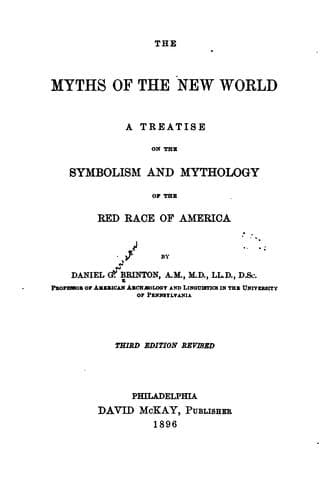
The Myths of the New World: A Treatise on the Symbolism and Mythology of the Red Race of AmericaBrinton, Daniel G. (Daniel Garrison)
Religion
The Myths of the New World: A Treatise on the Symbolism and Mythology of the Red Race of America
Brinton, Daniel G. (Daniel Garrison)
Indian mythology; Indians -- Folklore
identified the one with the other. But the breath is nothing but wind.
How easy, therefore, to look upon the wind that moves up and down and to
and fro upon the earth, that carries the clouds, itself unseen, that
calls forth the terrible tempests and the various seasons, as the
breath, the spirit of God, as God himself? So in the Mosaic record of
creation, it is said "a mighty wind" passed over the formless sea and
brought forth the world, and when the Almighty gave to the clay a living
soul, he is said to have breathed into it "the wind of lives."
Armed with these analogies, we turn to the primitive tongues of America,
and find them there as distinct as in the Old World. In Dakota _niya_ is
literally breath, figuratively life; in Netela _piuts_ is life, breath,
and soul; _silla_, in Eskimo, means air, it means wind, but it is also
the word that conveys the highest idea of the world as a whole, and the
reasoning faculty. The supreme existence they call _Sillam Innua_, Owner
of the Air, or of the All; or _Sillam Nelega_, Lord of the Air or Wind.
In the Yakama tongue of Oregon _wkrisha_ signifies there is wind,
_wkrishwit_, life; with the Aztecs, _ehecatl_ expressed both air, life,
and the soul, and personified in their myths it was said to have been
born of the breath of Tezcatlipoca, their highest divinity, who himself
is often called Yoalliehecatl, the Wind of Night.[50-1]
The descent is, indeed, almost imperceptible which leads to the
personification of the wind as God, which merges this manifestation of
life and power in one with its unseen, unknown cause. Thus it was a
worthy epithet which the Creeks applied to their supreme invisible
ruler, when they addressed him as ESAUGETUH EMISSEE, Master of Breath,
and doubtless it was at first but a title of equivalent purport which
the Cherokees, their neighbors, were wont to employ, OONAWLEH UNGGI,
Eldest of Winds, but rapidly leading to a complete identification of the
divine with the natural phenomena of meteorology. This seems to have
taken place in the same group of nations, for the original Choctaw word
for Deity was HUSHTOLI, the Storm Wind.[51-1] The idea, indeed, was
constantly being lost in the symbol. In the legends of the Quiches, the
mysterious creative power is HURAKAN, a name of no signification in
their language, one which their remote ancestors brought with them from
the Antilles, which finds its meaning in the ancient tongue of Haiti,
and which, under the forms of _hurricane_, _ouragan_, _orkan_, was
adopted into European marine languages as the native name of the
terrible tornado of the Caribbean Sea.[51-2] Mixcohuatl, the Cloud
Serpent, chief divinity of several tribes in ancient Mexico, is to this
day the correct term in their language for the tropical whirlwind, and
the natives of Panama worshipped the same phenomenon under the name
Tuyra.[52-1] To kiss the air was in Peru the commonest and simplest sign
of adoration to the collective divinities.[52-2]
Public-domain text, read in full here on John Shaqi.
Reviews
Reviews
No reviews yet
Be the first to share your thoughts on this work.
Join the Discussion
Join the discussion
Sign in to leave a comment or review.
Sign InorCreate an account