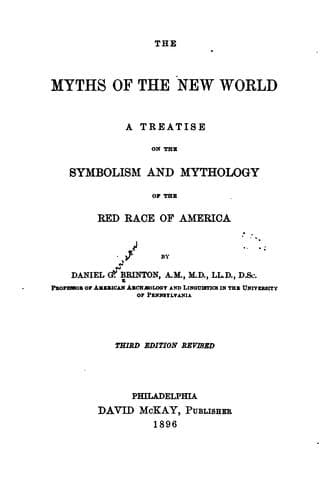
The Myths of the New World: A Treatise on the Symbolism and Mythology of the Red Race of America — John Shaqi
The Myths of the New World: A Treatise on the Symbolism and Mythology of the Red Race of AmericaBrinton, Daniel G. (Daniel Garrison)
Religion
The Myths of the New World: A Treatise on the Symbolism and Mythology of the Red Race of America
Brinton, Daniel G. (Daniel Garrison)
Indian mythology; Indians -- Folklore
Many writers on mythology have commented on the prominence so frequently
given to the winds. None have traced it to its true source. The facts of
meteorology have been thought all sufficient for a solution. As if man
ever did or ever could draw the idea of God from nature! In the identity
of wind with breath, of breath with life, of life with soul, of soul
with God, lies the far deeper and far truer reason, whose insensible
development I have here traced, in outline indeed, but confirmed by the
evidence of language itself.
Let none of these expressions, however, be construed to prove the
distinct recognition of One Supreme Being. Of monotheism either as
displayed in the one personal definite God of the Semitic races, or in
the dim pantheistic sense of the Brahmins, there was not a single
instance on the American continent. The missionaries found no word in
any of their languages fit to interpret _Deus_, God. How could they
expect it? The associations we attach to that name are the accumulated
fruits of nigh two thousand years of Christianity. The phrases Good
Spirit, Great Spirit, and similar ones, have occasioned endless
discrepancies in the minds of travellers. In most instances they are
entirely of modern origin, coined at the suggestion of missionaries,
applied to the white man's God. Very rarely do they bring any
conception of personality to the native mind, very rarely do they
signify any object of worship, perhaps never did in the olden times. The
Jesuit Relations state positively that there was no one immaterial god
recognized by the Algonkin tribes, and that the title, the Great Manito,
was introduced first by themselves in its personal sense.[53-1] The
supreme Iroquois Deity Neo or Hawaneu, triumphantly adduced by many
writers to show the monotheism underlying the native creeds, and upon
whose name Mr. Schoolcraft has built some philological reveries, turns
out on closer scrutiny to be the result of Christian instruction, and
the words themselves to be but corruptions of the French _Dieu_ and _le
bon Dieu_![53-2]
Public-domain text, read in full here on John Shaqi.
Reviews
Reviews
No reviews yet
Be the first to share your thoughts on this work.
Join the Discussion
Join the discussion
Sign in to leave a comment or review.
Sign InorCreate an account