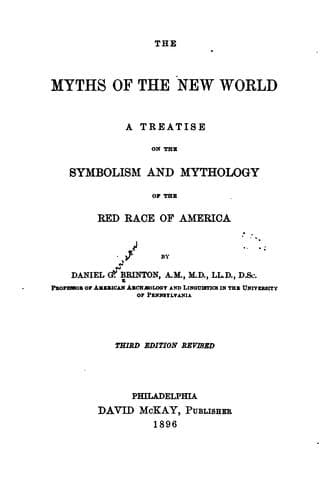
The Myths of the New World: A Treatise on the Symbolism and Mythology of the Red Race of AmericaBrinton, Daniel G. (Daniel Garrison)
Religion
The Myths of the New World: A Treatise on the Symbolism and Mythology of the Red Race of America
Brinton, Daniel G. (Daniel Garrison)
Indian mythology; Indians -- Folklore
Innumerable mysterious forces are in activity around the child of
nature; he feels within him something that tells him they are not of his
kind, and yet not altogether different from him; he sums them up in one
word drawn from sensuous experience. Does he wish to express still more
forcibly this sentiment, he doubles the word, or prefixes an adjective,
or adds an affix, as the genius of his language may dictate. But it
still remains to him but an unapplied abstraction, a mere category of
thought, a frame for the All. It is never the object of veneration or
sacrifice, no myth brings it down to his comprehension, it is not
installed in his temples. Man cannot escape the belief that behind all
form is one essence; but the moment he would seize and define it, it
eludes his grasp, and by a sorcery more sadly ludicrous than that which
blinded Titania, he worships not the Infinite he thinks but a base idol
of his own making. As in the Zend Avesta behind the eternal struggle of
Ormuzd and Ahriman looms up the undisturbed and infinite Zeruana
Akerana, as in the pages of the Greek poets we here and there catch
glimpses of a Zeus who is not he throned on Olympus, nor he who takes
part in the wrangles of the gods, but stands far off and alone, one yet
all, "who was, who is, who will be," so the belief in an Unseen Spirit,
who asks neither supplication nor sacrifice, who, as the natives of
Texas told Joutel in 1684, "does not concern himself about things here
below,"[54-1] who has no name to call him by, and is never a figure in
mythology, was doubtless occasionally present to their minds. It was
present not more but far less distinctly and often not at all in the
more savage tribes, and no assertion can be more contrary to the laws of
religious progress than that which pretends that a purer and more
monotheistic religion exists among nations devoid of mythology. There
are only two instances on the American continent where the worship of an
immaterial God was definitely instituted, and these as the highest
conquests of American natural religions deserve especial mention.
They occurred, as we might expect, in the two most civilized nations,
the Quichuas of Peru, and the Nahuas of Tezcuco. It is related that
about the year 1440, at a grand religious council held at the
consecration of the newly-built temple of the Sun at Cuzco, the Inca
Yupanqui rose before the assembled multitude and spoke somewhat as
follows:--
Public-domain text, read in full here on John Shaqi.
Reviews
Reviews
No reviews yet
Be the first to share your thoughts on this work.
Join the Discussion
Join the discussion
Sign in to leave a comment or review.
Sign InorCreate an account