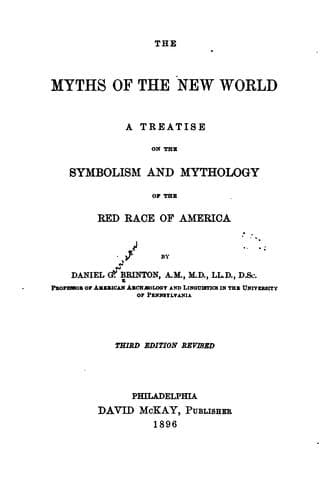
The Myths of the New World: A Treatise on the Symbolism and Mythology of the Red Race of AmericaBrinton, Daniel G. (Daniel Garrison)
Religion
The Myths of the New World: A Treatise on the Symbolism and Mythology of the Red Race of America
Brinton, Daniel G. (Daniel Garrison)
Indian mythology; Indians -- Folklore
"Many say that the Sun is the Maker of all things. But he who makes
should abide by what he has made. Now many things happen when the Sun is
absent; therefore he cannot be the universal creator. And that he is
alive at all is doubtful, for his trips do not tire him. Were he a
living thing, he would grow weary like ourselves; were he free, he would
visit other parts of the heavens. He is like a tethered beast who makes
a daily round under the eye of a master; he is like an arrow, which must
go whither it is sent, not whither it wishes. I tell you that he, our
Father and Master the Sun, must have a lord and master more powerful
than himself, who constrains him to his daily circuit without pause or
rest."[55-1]
To express this greatest of all existences, a name was proclaimed, based
upon that of the highest divinities known to the ancient Aymara race,
Illatici Viracocha Pachacamac, literally, the thunder vase, the foam of
the sea, animating the world, mysterious and symbolic names drawn from
the deepest religious instincts of the soul, whose hidden meanings will
be unravelled hereafter. A temple was constructed in a vale by the sea
near Callao, wherein his worship was to be conducted without images or
human sacrifices. The Inca was ahead of his age, however, and when the
Spaniards visited the temple of Pachacamac in 1525, they found not only
the walls adorned with hideous paintings, but an ugly idol of wood
representing a man of colossal proportions set up therein, and receiving
the prayers of the votaries.[56-1]
No better success attended the attempt of Nezahuatl, lord of Tezcuco,
which took place about the same time. He had long prayed to the gods of
his forefathers for a son to inherit his kingdom, and the altars had
smoked vainly with the blood of slaughtered victims. At length, in
indignation and despair, the prince exclaimed, "Verily, these gods that
I am adoring, what are they but idols of stone without speech or
feeling? They could not have made the beauty of the heaven, the sun, the
moon, and the stars which adorn it, and which light the earth, with its
countless streams, its fountains and waters, its trees and plants, and
its various inhabitants. There must be some god, invisible and unknown,
who is the universal creator. He alone can console me in my affliction
and take away my sorrow." Strengthened in this conviction by a timely
fulfilment of his heart's desire, he erected a temple nine stories high
to represent the nine heavens, which he dedicated "to the Unknown God,
the Cause of Causes." This temple, he ordained, should never be polluted
by blood, nor should any graven image ever be set up within its
precincts.[57-1]
Public-domain text, read in full here on John Shaqi.
Reviews
Reviews
No reviews yet
Be the first to share your thoughts on this work.
Join the Discussion
Join the discussion
Sign in to leave a comment or review.
Sign InorCreate an account