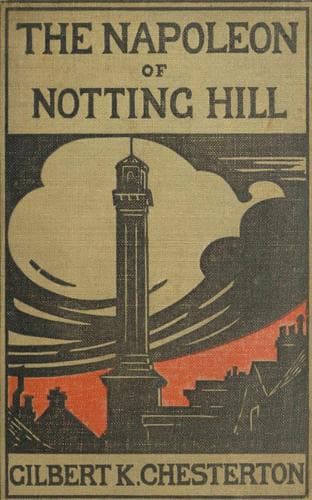
The Napoleon of Notting HillChesterton, G. K. (Gilbert Keith)
Science
The Napoleon of Notting Hill
Chesterton, G. K. (Gilbert Keith)
Fantasy fiction; Notting Hill (London, England) -- Fiction; Political fiction
But in the beginning of the twentieth century the game of Cheat the
Prophet was made far more difficult than it had ever been before. The
reason was, that there were so many prophets and so many prophecies,
that it was difficult to elude all their ingenuities. When a man did
something free and frantic and entirely his own, a horrible thought
struck him afterwards; it might have been predicted. Whenever a duke
climbed a lamp-post, when a dean got drunk, he could not be really
happy, he could not be certain that he was not fulfilling some
prophecy. In the beginning of the twentieth century you could not see
the ground for clever men. They were so common that a stupid man was
quite exceptional, and when they found him, they followed him in
crowds down the street and treasured him up and gave him some high
post in the State. And all these clever men were at work giving
accounts of what would happen in the next age, all quite clear, all
quite keen-sighted and ruthless, and all quite different. And it
seemed that the good old game of hoodwinking your ancestors could not
really be managed this time, because the ancestors neglected meat and
sleep and practical politics, so that they might meditate day and
night on what their descendants would be likely to do.
But the way the prophets of the twentieth century went to work was
this. They took something or other that was certainly going on in
their time, and then said that it would go on more and more until
something extraordinary happened. And very often they added that in
some odd place that extraordinary thing had happened, and that it
showed the signs of the times.
Thus, for instance, there were Mr. H. G. Wells and others, who thought
that science would take charge of the future; and just as the
motor-car was quicker than the coach, so some lovely thing would be
quicker than the motor-car; and so on for ever. And there arose from
their ashes Dr. Quilp, who said that a man could be sent on his
machine so fast round the world that he could keep up a long, chatty
conversation in some old-world village by saying a word of a sentence
each time he came round. And it was said that the experiment had been
tried on an apoplectic old major, who was sent round the world so fast
that there seemed to be (to the inhabitants of some other star) a
continuous band round the earth of white whiskers, red complexion and
tweeds--a thing like the ring of Saturn.
Public-domain text, read in full here on John Shaqi.
Reviews
Reviews
No reviews yet
Be the first to share your thoughts on this work.
Join the Discussion
Join the discussion
Sign in to leave a comment or review.
Sign InorCreate an account