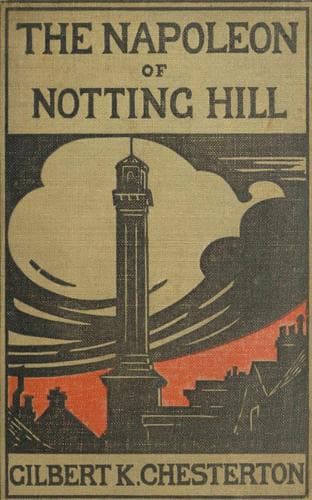
The Napoleon of Notting HillChesterton, G. K. (Gilbert Keith)
Science
The Napoleon of Notting Hill
Chesterton, G. K. (Gilbert Keith)
Fantasy fiction; Notting Hill (London, England) -- Fiction; Political fiction
Then there was the opposite school. There was Mr. Edward Carpenter,
who thought we should in a very short time return to Nature, and live
simply and slowly as the animals do. And Edward Carpenter was followed
by James Pickie, D.D. (of Pocohontas College), who said that men were
immensely improved by grazing, or taking their food slowly and
continuously, after the manner of cows. And he said that he had, with
the most encouraging results, turned city men out on all fours in a
field covered with veal cutlets. Then Tolstoy and the Humanitarians
said that the world was growing more merciful, and therefore no one
would ever desire to kill. And Mr. Mick not only became a vegetarian,
but at length declared vegetarianism doomed ("shedding," as he called
it finely, "the green blood of the silent animals"), and predicted
that men in a better age would live on nothing but salt. And then
came the pamphlet from Oregon (where the thing was tried), the
pamphlet called "Why should Salt suffer?" and there was more trouble.
[Illustration: CITY MEN OUT ON ALL FOURS IN A FIELD COVERED WITH VEAL
CUTLETS.]
And on the other hand, some people were predicting that the lines of
kinship would become narrower and sterner. There was Mr. Cecil Rhodes,
who thought that the one thing of the future was the British Empire,
and that there would be a gulf between those who were of the Empire
and those who were not, between the Chinaman in Hong Kong and the
Chinaman outside, between the Spaniard on the Rock of Gibraltar and
the Spaniard off it, similar to the gulf between man and the lower
animals. And in the same way his impetuous friend, Dr. Zoppi ("the
Paul of Anglo-Saxonism"), carried it yet further, and held that, as a
result of this view, cannibalism should be held to mean eating a
member of the Empire, not eating one of the subject peoples, who
should, he said, be killed without needless pain. His horror at the
idea of eating a man in British Guiana showed how they misunderstood
his stoicism who thought him devoid of feeling. He was, however, in a
hard position; as it was said that he had attempted the experiment,
and, living in London, had to subsist entirely on Italian
organ-grinders. And his end was terrible, for just when he had begun,
Sir Paul Swiller read his great paper at the Royal Society, proving
that the savages were not only quite right in eating their enemies,
but right on moral and hygienic grounds, since it was true that the
qualities of the enemy, when eaten, passed into the eater. The notion
that the nature of an Italian organ-man was irrevocably growing and
burgeoning inside him was almost more than the kindly old professor
could bear.
Public-domain text, read in full here on John Shaqi.
Reviews
Reviews
No reviews yet
Be the first to share your thoughts on this work.
Join the Discussion
Join the discussion
Sign in to leave a comment or review.
Sign InorCreate an account