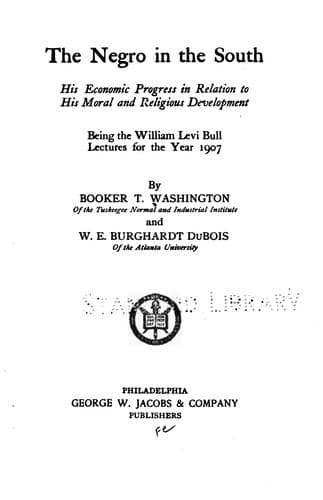
The Negro in the South: His Economic Progress in Relation to his Moral and Religious DevelopmentDu Bois, W. E. B. (William Edward Burghardt)
History
The Negro in the South: His Economic Progress in Relation to his Moral and Religious Development
Du Bois, W. E. B. (William Edward Burghardt)
African Americans -- Southern States
Let me illustrate the value of the economic and industrial training of
the Negro: If one chooses, let him try this plan which I have tried on
a good many occasions. Go into any village or town, North or South,
enter their Baptist and Methodist churches--for the most part they
belong to the Baptist Church--and ask their pastors to point out to
you the most reliable, progressive and leading colored man in the
community, the man who is most given to putting his religious
teachings into practice in his daily life, and in a majority of cases
one will have pointed out to him a Negro who learned a trade or got
some special economic training during the days of slavery,--in all
probability an individual who has become the owner of a little piece
of land, who lives in his own house.
Now what lessons for the work that is before us can you and I learn
from what I have attempted to say? The lesson suggested in the
elevation of the black race in America will apply with equal force, in
my opinion, to the inculcating of moral and Christian principles into
_any_ race, regardless of color, that is in the same relative stage of
civilization. Here let me add that in all my advocacy of the value of
industrial training I have never done so because my people are black;
I would advocate the same kind of training for any race that is on
the same plane of civilization as our people are found on at the
present time.
But as to the lesson which may prove of direct interest, so far as you
are concerned. In the old days, the method of converting the heathen
to Christianity was very largely abstract. The Bible was, in most
cases, the only argument. In the conversion of the heathen to
Christianity or in raising the standard of moral and Christian living
for any people, I argue that in the use of the economic element and
the teaching of the industries we should be guided by the same rules
that are now used in the most advanced methods of ordinary
school-teaching--that is, to begin with the known and gradually
advance to the unknown; we should advance from the concrete to the
abstract. In doing this, industrial education, it seems to me,
furnishes a tremendously good opportunity.
Let me illustrate: Not long ago a missionary who was going into a
foreign field very kindly asked of me advice as to how he should
proceed to convert the people to Christianity. I asked him, first,
upon what the people depended mostly for a living in the country where
he was to labor; he replied that for the most part they were engaged
in sheep raising. I said to him at once that if I were going into that
country as a missionary, I should begin my efforts by teaching the
people to raise more sheep and better sheep. If he could convince them
that Christianity could raise more sheep and better sheep than
paganism, he would at once get a hold upon their sympathy and
confidence in a way he could not do by following more abstract methods
of converting them.
Public-domain text, read in full here on John Shaqi.
Reviews
Reviews
No reviews yet
Be the first to share your thoughts on this work.
Join the Discussion
Join the discussion
Sign in to leave a comment or review.
Sign InorCreate an account