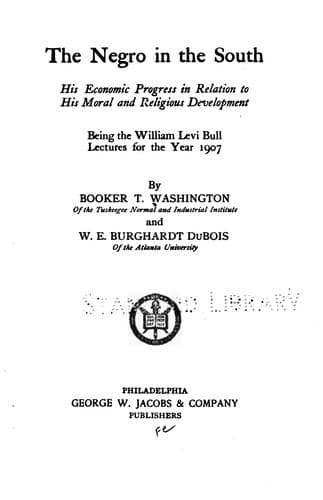
The Negro in the South: His Economic Progress in Relation to his Moral and Religious DevelopmentDu Bois, W. E. B. (William Edward Burghardt)
History
The Negro in the South: His Economic Progress in Relation to his Moral and Religious Development
Du Bois, W. E. B. (William Edward Burghardt)
African Americans -- Southern States
The average man can discern more quickly the difference between good
sheep and bad sheep, than he can the difference between Unitarianism
and Trinitarianism.
If the Christian missionary can gradually teach the heathen how to
build a better house than he has used, how to make better clothes, how
to grow, prepare and secure better food for his daily meals, the
missionary will have gone a long way, may I repeat, toward securing
the confidence of the heathen and will have laid the foundation in
this concrete manner for interesting the pagan in a higher moral life
and in getting him to appreciate the difference between the heathen
life and the Christian life. In teaching the child to read we use the
objective method; in converting the heathen we should employ the same
method--and this means the economic or industrial method.
Some six years ago a group of Tuskeegee graduates and former students
went to Africa for the purpose of giving the natives in a certain
territory of West Africa training in methods of raising American
cotton. They did not go there primarily as missionaries, nor was their
chief end the conversion of these pagans to Christianity. Naturally,
they began their work by training the natives how to cultivate their
land differently, how and when to plant the crop, and when to harvest
it, and gradually taught them how to use a small hand gin in getting
the cotton ready for market.
Largely through the leadership of this group of Tuskeegee students,
there is shipped from this section of Africa to the Berlin market each
year many bales of cotton. The natives have learned through the
teaching of these men to grow more cotton and better cotton. They have
learned to use their time, have learned that by working systematically
and regularly they can increase their income and thus add to their
independence and supply their wants. Not only this, but in order that
these people might be fitted for continuous and regular service in the
cotton field, their houses have been improved and the natives have
been taught how to take better care of their bodies. In a word,
during the years that these Tuskeegee people have been in the
community they have improved the entire economic, industrial, and
physical life of the people in this immediate territory.
Public-domain text, read in full here on John Shaqi.
Reviews
Reviews
No reviews yet
Be the first to share your thoughts on this work.
Join the Discussion
Join the discussion
Sign in to leave a comment or review.
Sign InorCreate an account