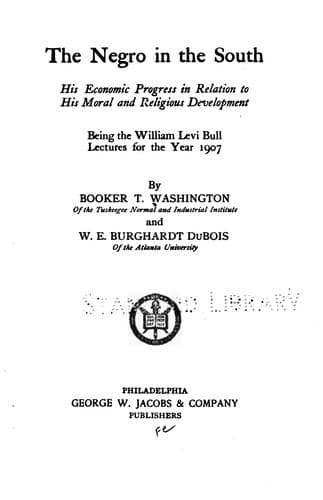
The Negro in the South: His Economic Progress in Relation to his Moral and Religious DevelopmentDu Bois, W. E. B. (William Edward Burghardt)
History
The Negro in the South: His Economic Progress in Relation to his Moral and Religious Development
Du Bois, W. E. B. (William Edward Burghardt)
African Americans -- Southern States
Such conditions were unusual in the case of a race that had been
occupying so low a place in the civilization of another people. They
resulted from the fact that in slavery when the master wanted a pair
of shoes made, he went to the Negro shoemaker for those shoes; when he
wanted a suit of clothes, he went to the Negro tailor for those
clothes; and when he wanted a house built, he consulted the Negro
carpenter and mason about the plans and cost--thus the two races
learned to do business with each other. It was an easy step from this
to a higher plane of business, hence immediately after the war the
Negro found that he could become a dry goods merchant, a grocery
merchant, start a bank, go into real estate dealing, and secure the
trade not only of his own people, but also of the white man, who was
glad to do business with him and thought nothing of it.
In my own town of Tuskeegee there is a colored merchant who, not
excepting any other merchant, has the largest trade in that county in
retail groceries, and in a recent conversation with him he said that
for thirty-five years his customers had been among the best white
families of the county. More than a dozen times have I met the man who
owned this Negro in the days of slavery and he expressed himself as
more than pleased that his former slave had attained the honor of
being the most successful grocery dealer in the town of Tuskeegee.
You would be surprised, if you were to inquire into the facts, to
know how the Negro has grown in this direction. In the Southern states
there are one hundred and fifteen drug stores owned by Negroes. In
Anniston, Alabama, there are two large drug stores owned by black
people, and in one section a wholesale drug store owned and operated
successfully by a black man. The Negro who to-day owns and operates
that large wholesale drug store, selling drugs to the white as well as
colored retail druggists, was a slave, I think, until he was twelve or
fifteen years of age. It is interesting to know that more banks have
been organized in the last three years in the state of Mississippi
than ever before. There have been ten banks organized since Vardaman
became governor of the state.
For the reasons I have mentioned, the Negro in the South has not only
found a practically free field in the commercial world, but in the
world of skilled labor. Such a field is not open to him in such a
degree in any other part of the United States, or perhaps in the
world, as is open in the South. All of this has had a tremendously
strong bearing in developing the Negro's moral and Christian life.
In proportion to their numbers, I question whether so large a
proportion of any other race are members of some Christian Church as
is true of the American Negro. In many cases their practical ideas of
Christianity are crude, and their daily practice of religion is far
from satisfactory; still the foundation is laid, upon which can be
builded a rational, practical and helpful Christian life.
Public-domain text, read in full here on John Shaqi.
Reviews
Reviews
No reviews yet
Be the first to share your thoughts on this work.
Join the Discussion
Join the discussion
Sign in to leave a comment or review.
Sign InorCreate an account