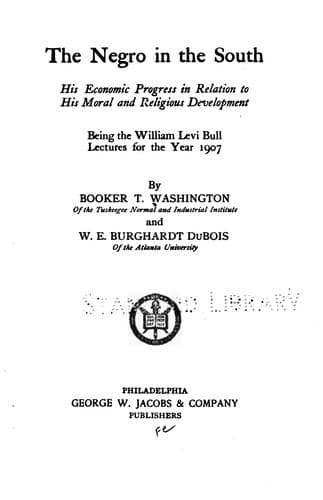
The Negro in the South: His Economic Progress in Relation to his Moral and Religious DevelopmentDu Bois, W. E. B. (William Edward Burghardt)
History
The Negro in the South: His Economic Progress in Relation to his Moral and Religious Development
Du Bois, W. E. B. (William Edward Burghardt)
African Americans -- Southern States
The result is, as one of the men stated on his last visit to
Tuskeegee, there is little difficulty now in getting the children of
these people to attend Sunday-school and the older people to attend
church; in fact, in a natural, logical manner they seem to have been
converted to the idea that the religion practiced by these Tuskeegee
men is superior to their own. They believe this firmly, because they
have seen that better results have been produced through the Christian
influence of these Tuskeegee men than has been produced when they had
no such leadership. If these Tuskeegee people had gone there as
missionaries of the old type and had confined themselves to abstract
teachings of the Bible alone, it would have required many years to
have brought about the results which have been attained within a few
years.
Some time ago in Montgomery, Alabama, there was a church, attended by
members of my race, which happened to be located not very far from the
residence of a white family. The cook who served in this white family
attended this church to which I refer. The members of the church made
considerable noise in their singing, shouting, and praying, and after
a while the white family grew rather exasperated because of this
noise. One Sunday the church services were prolonged until an unusual
hour and there was more noise than usual; so the next morning when the
cook came, the lady of the house called her into the sitting-room, and
said: "Jane, why in the world do you make so much noise in your
worship, in your singing, praying, and shouting? Why don't you be
orderly, quiet, and systematic in your worship? Why, Jane, in the
Bible we read that in the building of Solomon's Temple, no noise
pervaded the silence of the builders. Why can you not worship in the
same way?" The old colored woman looked at her mistress for a few
moments and said: "Lordy, missus, you don't know what we's doing;
Lordy, missus, you don't know what we's striving at; we's just
blasting out de stone for de foundation ob de Temple." So, my friends,
when you hear us laying so much emphasis upon the moral and economic
training, upon home-getting and all those things, remember we are
simply trying to teach our people to blast out the foundation of the
temple in which we are to grow and be useful.
Says the Psalmist: "O Lord, how manifold are Thy works; in wisdom hast
Thou made them all; the earth is full of Thy riches." I believe that a
wise Providence means that we shall use all the material riches of the
earth: soil, wood, minerals, stones, water, air, and what not, as a
means through which to reach God and glorify Him.
I have thus briefly dealt with the problem of slavery in its relations
to the economic and moral growth of my people. Each one of these
periods has presented a problem of tremendous importance and
seriousness to your race and to my race.
Public-domain text, read in full here on John Shaqi.
Reviews
Reviews
No reviews yet
Be the first to share your thoughts on this work.
Join the Discussion
Join the discussion
Sign in to leave a comment or review.
Sign InorCreate an account