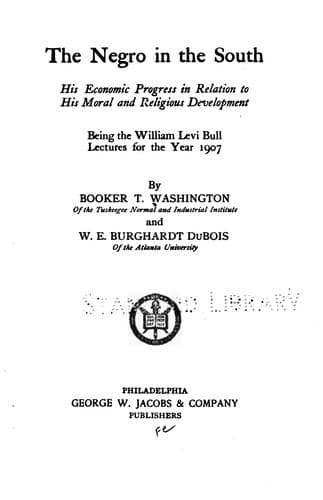
The Negro in the South: His Economic Progress in Relation to his Moral and Religious DevelopmentDu Bois, W. E. B. (William Edward Burghardt)
History
The Negro in the South: His Economic Progress in Relation to his Moral and Religious Development
Du Bois, W. E. B. (William Edward Burghardt)
African Americans -- Southern States
I believe that it is possible for a race, as it is for an individual,
to learn to live up in such a high atmosphere that there is no human
law that can prevail against it. There is no man who can pass a law to
affect the Negro in relation to his singing, his peace, and his
self-control. Wherever I go I would enter St. Paul's atmosphere and,
living through and in that spirit, we will grow and make progress and,
notwithstanding discouragements and mistakes, we will become an
increasingly strong part of the Christian citizenship of this
republic.
* * * * *
CHAPTER II
THE ECONOMIC DEVELOPMENT OF THE NEGRO RACE SINCE ITS EMANCIPATION
* * * * *
CHAPTER II
THE ECONOMIC DEVELOPMENT OF THE NEGRO RACE SINCE ITS EMANCIPATION
In the preceding chapter, I referred to some of the things which the
Negro brought with him out of slavery into his life of freedom that he
used to his advantage. I shall now discuss those things that were to
his disadvantage.
We must bear in mind that one of the influences of slavery was to
impress upon both master and slave the fact that labor with the hand
was not dignified, was disgraceful, that labor of this character was
something to be escaped, to be gotten rid of just as soon as possible.
Hence, it was very natural that the Negro race looked forward to the
day of freedom as being that period when it would be delivered from
all necessity of laboring with the hand. It was natural that a large
proportion of the race, immediately after its freedom, should make the
mistake of confusing freedom with license. Under the circumstances,
any other race would have acted in the same manner.
One of the first and most important lessons, then, to be taught the
Negro when he became free was the one that labor with the hand or with
the head, so far from being something to be dreaded and shunned, was
something that was dignified and something that should be sought,
loved, and appreciated. Here began the function of the industrial
school for the education of the Negro. This was the uppermost idea of
General Armstrong, the father of industrial education of the Negro.
And permit me to say right here, that, in my opinion, General
Armstrong, more than any other single individual, is the father of
industrial education not only for the Negro, but in a large measure
for the entire United States. For you must always bear in mind that,
prior to the establishment of such institutions as the Hampton
Institute, there was practically no systematic industrial training
given for either black or white people, either North or South. At the
present time more attention is being paid to this kind of education
for white boys and girls than is being given to black boys and girls.
Public-domain text, read in full here on John Shaqi.
Reviews
Reviews
No reviews yet
Be the first to share your thoughts on this work.
Join the Discussion
Join the discussion
Sign in to leave a comment or review.
Sign InorCreate an account