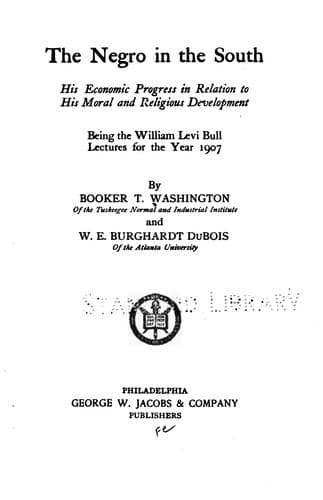
The Negro in the South: His Economic Progress in Relation to his Moral and Religious Development — John Shaqi
The Negro in the South: His Economic Progress in Relation to his Moral and Religious DevelopmentDu Bois, W. E. B. (William Edward Burghardt)
History
The Negro in the South: His Economic Progress in Relation to his Moral and Religious Development
Du Bois, W. E. B. (William Edward Burghardt)
African Americans -- Southern States
It is an interesting thought that this kind of education, started
thirty-five years ago for the education of the Negro, has spread
throughout the United States, in the North and West, and has taken
hold upon the people who once enslaved the Negro in our Southern
states.
When industrial schools were first established in the South for the
education of members of my race, stubborn objection was raised against
them on the part of black people. This was the experience of Hampton,
and this in later years was the experience of the Tuskeegee
Institute.
I remember that for a number of years after the founding of the
Tuskeegee Institute, objection on the part of parents and on the part
of students poured in upon me from day to day. The parents said that
they wanted their children taught "the book," but they did not want
them taught anything concerning farming or household duties. It was
curious to note how most of the people worshiped "the book." The
parent did not care what was inside the book; the harder and the
longer the name of it, the better it satisfied the parent every time,
and the more books you could require the child to purchase, the better
teacher you were. His reputation as a first-class pedagogue was added
to very largely in that section if the teacher required the child to
buy a long string of books each year and each month. I found some
white people who had the same idea.
They reminded me further that the Negro for two hundred and fifty
years as a slave had been worked, and now that the race was free they
contended that their children ought not to be taught to work and
especially while in school. In answer to these objections I said to
them that it was true that the race had been worked in slavery, but
the great lesson which we wanted to learn in freedom was to work. I
explained to them that there was a vast difference between being
worked and working. I said to them that being worked meant
degradation, that working meant civilization.
We have gone on at Tuskeegee from that day until this, emphasizing the
difference between being worked and working, until, I am glad to say,
every sign of opposition against any form of industrial education has
completely disappeared from among parents and students; and I but
state the truth when I say that industrial education, whether on the
farm or in the carpenter shop or in the cooking class, is even more
sought after at Tuskeegee than is training in purely academic
branches. It has been ten years since I have had a single application
for other than a form of industrial training. On the contrary, this
kind of training is so popular among them that we have many
applications from other students who live in other states who wish to
devote themselves wholly to the industrial side of education.
Public-domain text, read in full here on John Shaqi.
Reviews
Reviews
No reviews yet
Be the first to share your thoughts on this work.
Join the Discussion
Join the discussion
Sign in to leave a comment or review.
Sign InorCreate an account