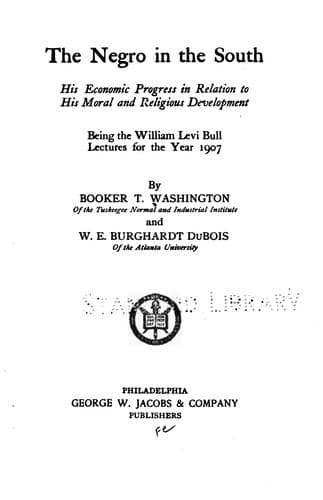
The Negro in the South: His Economic Progress in Relation to his Moral and Religious DevelopmentDu Bois, W. E. B. (William Edward Burghardt)
History
The Negro in the South: His Economic Progress in Relation to his Moral and Religious Development
Du Bois, W. E. B. (William Edward Burghardt)
African Americans -- Southern States
From Hampton and Tuskeegee and other large educational centres the
idea of industrial education has spread throughout the South, and
there are now scores of institutions that are giving this kind of
training in a most effective and helpful manner; so that, in my
opinion, the greatest thing that we have accomplished for the Negro
race within the last twenty-five years has been to rid his mind of all
idea of labor's being degrading. This has been no inconsiderable
achievement. If I were asked to point out the greatest change
accomplished for the Negro race, I would say that it was not a
tangible, physical change, but a change of the spirit,--the new idea
of our people with respect to Negro labor.
Industrial education has had another value wherever it has been put
into practice, that is in starting the Negro off in his new life in a
natural, logical, sensible manner instead of allowing him to be led
into temptation to begin life in an artificial atmosphere without any
real foundation.
All races that have reached success and have influenced the world for
righteousness have laid their foundation at one stage of their career
in the intelligent and successful cultivation of the soil; that is,
have begun their free life by coming into contact with earth and wood
and stone and minerals. Any people that begins on a natural foundation
of this kind, rises slowly but naturally and gradually in the world.
In my work at Tuskeegee and in what I have endeavored to accomplish in
writing and in speaking before the public, I have always found it
important to stick to nature as closely as possible, and the same
policy should be followed with a race. If you will excuse my making a
personal reference, just as often as I can when I am at home, I like
to get my hoe and dig in my garden, to come into contact with real
earth, or to touch my pigs and fowls. Whenever I want new material for
an address or a magazine article, I follow the plan of getting away
from the town with its artificial surroundings and getting back into
the country, where I can sleep in a log cabin and eat the food of the
farmer, go among the people at work on the plantations and hear them
tell their experiences. I have gotten more material in this way than I
have by reading books.
Public-domain text, read in full here on John Shaqi.
Reviews
Reviews
No reviews yet
Be the first to share your thoughts on this work.
Join the Discussion
Join the discussion
Sign in to leave a comment or review.
Sign InorCreate an account