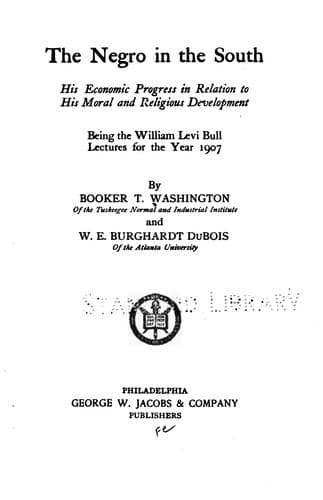
The Negro in the South: His Economic Progress in Relation to his Moral and Religious Development — John Shaqi
The Negro in the South: His Economic Progress in Relation to his Moral and Religious DevelopmentDu Bois, W. E. B. (William Edward Burghardt)
History
The Negro in the South: His Economic Progress in Relation to his Moral and Religious Development
Du Bois, W. E. B. (William Edward Burghardt)
African Americans -- Southern States
I would not have you understand that I emphasize material possessions
as the chief thing in life or as an object within itself. I emphasize
economic growth because the civilization of the world teaches that the
possession of a certain amount of material wealth indicates the
ability of a race to exercise self-control, to plan to-day for
to-morrow, to do without to-day in order that it may possess
to-morrow. In other words, a race, like an individual, becomes highly
civilized and useful in proportion as it learns to use the good things
of this earth, not as an end, but as a means toward promoting its own
moral and religious growth and the prosperity and happiness of the
world. This is what I advocate for my race; it is what I would
advocate for any race.
The average white man of America, in passing judgment upon the black
race, very often overlooks the fact that geographically and physically
the semi-barbarous Negro race has been thrown right down in the centre
of the highest civilization that the world knows anything about.
Consciously or unconsciously, you compare the Negro's progress with
your progress, forgetting, when you are doing it, that you are placing
a pretty severe test on the members of my race. If, for example, we
were compared with the civilization of the Oriental countries, the
test would not be so severe. But we have been placed in the midst of a
pushing, surging, restless, conquering, successful civilization, and
you must acknowledge that when the American white man wants to lead,
no other race can go far ahead. In fact, he would have the whole
field to himself. The progress of the Negro will be in proportion as
they learn to get the material things of this world, consecrate them,
and weave them into the service of our Heavenly Father.
In conclusion, may I say that I hope the people of this country, North
and South, will learn to pray more and more; and, as they pray, to put
their hands upon their hearts and then ask God if they were placed in
the Negro's state, how, under the circumstances, would they like to be
treated by their fellows. Conscience will answer the question.
* * * * *
CHAPTER III
THE ECONOMIC REVOLUTION IN THE SOUTH
* * * * *
CHAPTER III
THE ECONOMIC REVOLUTION IN THE SOUTH
Two questions may be asked of any group of human beings: first, How do
they earn their living, and secondly, What is their attitude toward
life? The first relates to the economic history and condition of that
people; the second is a study of their religion. In these two essays I
am to treat the first of these questions under the subject: The
Economic Revolution in the South, and the second under the subject:
Christianity in the South.
Public-domain text, read in full here on John Shaqi.
Reviews
Reviews
No reviews yet
Be the first to share your thoughts on this work.
Join the Discussion
Join the discussion
Sign in to leave a comment or review.
Sign InorCreate an account