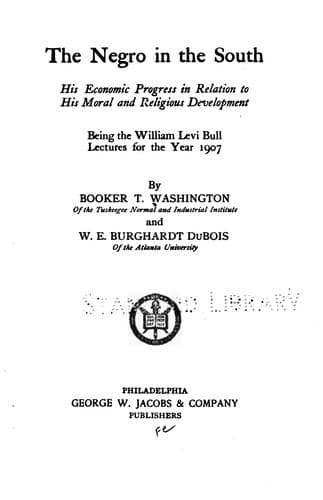
The Negro in the South: His Economic Progress in Relation to his Moral and Religious DevelopmentDu Bois, W. E. B. (William Edward Burghardt)
History
The Negro in the South: His Economic Progress in Relation to his Moral and Religious Development
Du Bois, W. E. B. (William Edward Burghardt)
African Americans -- Southern States
The industrial back-set of the South meant of course but one thing:
the discovery of the paradox of slavery, the turning from the
mistake, and the adoption of remedial measures which should usher into
the South the same industrial revolution in methods of work which
Europe saw begin a century ago. This is exactly what has happened, and
to-day the Industrial Revolution is beginning south of Mason and
Dixon's line. The forecast of change was apparent by 1850. Slavery
still paid then--was still an economic success, but only under
conditions which became more and more impossible of realization
because of the factory system and the new industrial conditions in the
rest of the world (see Note 3).
It was, in other words, an attempt at an industrial system with the
lowest wages, the most oppressive labor laws, and the best natural
advantages. Such a system at such a time carried its own sentence of
death: fertile land was becoming scarce in the forties, the horrors of
the slave trade had shocked even the eighteenth century, and southern
labor laws which made knowledge a crime and migration of laborers a
capital offense, simply could not be enforced. It was in vain that the
solidly united capitalistic classes of the South threw themselves
bodily into the fray--raped Mexico, filibustered in Cuba and Central
America, encouraged slave-smuggling (see Note 4), and bullied the
hesitating North; their economic doom was written even if militant
Abolitionism had not appeared.
The economic student could have foretold and did foretell easily in
the forties and fifties that slavery in the South was doomed (see Note
5): even if all available territory had been thrown wide to the slave
system, slavery could not possibly have stayed in Kansas and Utah, in
New Mexico or in Arizona; it could have stayed only temporarily in
Missouri and in Texas. It had already reached its territorial limit,
it was bound to have evolved something different. It will always be an
interesting speculation as to how soon this economic necessity would
have been recognized; whether the South would have had the acumen
eventually to see the end, and what sort of gradual change could have
come about, had it not been for the political crisis precipitated in
1861.
Then came the war--that disgraceful episode of civil strife when,
leaving the arguments of men, the nation appealed to the last resort
of dogs, murdering and ravishing each other for four long shameful
years (see Note 6).
Public-domain text, read in full here on John Shaqi.
Reviews
Reviews
No reviews yet
Be the first to share your thoughts on this work.
Join the Discussion
Join the discussion
Sign in to leave a comment or review.
Sign InorCreate an account