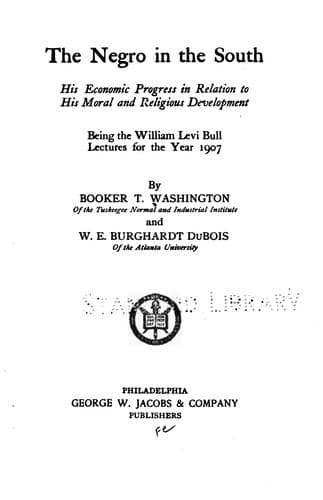
The Negro in the South: His Economic Progress in Relation to his Moral and Religious DevelopmentDu Bois, W. E. B. (William Edward Burghardt)
History
The Negro in the South: His Economic Progress in Relation to his Moral and Religious Development
Du Bois, W. E. B. (William Edward Burghardt)
African Americans -- Southern States
When this nightmare had passed there came, after the resulting period
of disorder, a new régime, a new problem of labor, a new industrial
order. Not only that, but gradually in the decade 1870-1880 there were
added to the South four new economic activities: first, the iron
industry; second, the manufacture of cotton cloth; third, the
transportation of these goods to, from, and through the South; and
fourth, the general exchange of goods in this growing Southern
industrial population--in other words, the Industrial Revolution was
beginning in the South. So that the South of the 80's was a different
South from the South of the 60's, not simply by reason of emancipation
but by reason of new economic possibilities.
However, this change could not go on unhindered by the mistakes of the
past. With all that was new in the South, there was also much that was
old, and of these old things the most important were the Ideals which
slavery handed down--ideals of government, of labor, of caste.
Consequently when the South tried to use its new freed labor on its
new industrial possibilities, it went to the problem full of the
ideals of slavery, and it made four separate attempts. In the first
place it was perfectly natural for a land which had said for
generations that free Negro labor was an impossibility, and free Negro
citizens unthinkable, to cherish a very distinct idea that the way to
get along with the emancipated Negro was to make him a slave in fact
if not in name. The idea that was back of the first apprentice laws
and the various labor codes passed directly after Lee's surrender was
that the labor of the blacks belonged to the former white owners by
right and could be directed only by force under a nominal wage system.
These labor codes therefore attempted to reëstablish slavery without a
slave trade (see Note 7).
These ill-advised attempts were frustrated by the Fifteenth Amendment
which made the freedmen voters. The Thirteenth Amendment did not
abolish slavery--it directed its abolition and the answer to it was
the labor codes. The Fourteenth Amendment gave the freedmen civil
rights and put a premium on granting them political rights, but the
premium was not accepted and the civil rights remained unenforced. The
Fifteenth Amendment went to the root of the matter by putting local
political power into the hands of the freedmen and their friends and
this made slavery and the slave system impossible.
Public-domain text, read in full here on John Shaqi.
Reviews
Reviews
No reviews yet
Be the first to share your thoughts on this work.
Join the Discussion
Join the discussion
Sign in to leave a comment or review.
Sign InorCreate an account