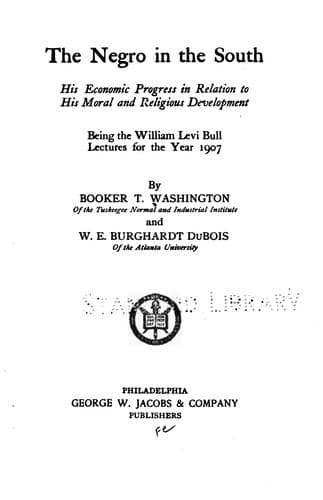
The Negro in the South: His Economic Progress in Relation to his Moral and Religious DevelopmentDu Bois, W. E. B. (William Edward Burghardt)
History
The Negro in the South: His Economic Progress in Relation to his Moral and Religious Development
Du Bois, W. E. B. (William Edward Burghardt)
African Americans -- Southern States
What the nation had before it then was not the nice academic question
as to whether it would be better to have as voters men of intelligence
or men of ignorance, whether it would be better to throw into the
electorate of a great modern country a mass of slaves or a mass of
college graduates--no such question came before the country; it was,
as we are fond of saying, a situation and not a theory that confronted
the country and that situation was this: here in the South we had
attempted to abolish slavery by act of legislature--it was not
abolished. The people who hitherto held power did not believe in its
real abolishment; a great and growing economic revolution fronted
them, cotton was still king. They were about to solve that problem--to
meet the Revolution--according to their former labor ideals.
One could not expect any other outcome. One could not in justice ask
them voluntarily to accept free black labor; the only possible way to
insure the solving of that economic problem with labor really free was
to put in the South a political power which should make slavery in
fact or inference forever impossible. This truth the great Thaddeus
Stephens saw, and with a statesmanship far greater than Lincoln's he
forced Negro suffrage on the South.
Although the new voters thus introduced in the South were crude and
ignorant, and in many ways ill-fitted to rule, nevertheless in the
fundamental postulates of American freedom and democracy they were
sane and sound. Some of them were silly, some were ignorant, and some
were venal, but they were not as silly as those who had fostered
slavery in the South, nor as ignorant as those who were determined to
perpetuate it, and the black voters of South Carolina never stole half
as much as the white voters of Pennsylvania are stealing to-day.
The eternal monument to these maligned victims of a nation's wrong is
the fact that they began the abolition of slavery in fact and not
merely attack it in theory, they established free schools, and they
passed laws on all subjects under which the white South is still
content to live (see Note 8). If these men had been protected in their
legal rights by the strong arm of the government, they would have been
able to protect themselves in a generation or so. They would have
increased in intelligence, responsibility, and power, and this the
South was determined to prevent. The North wavered; having put its
hand to the plow it looked back, and gradually allowed the black
peasantry of the South to be almost completely disfranchised. What
happened?
The time had passed for a reëstablishment of slavery, but serfdom and
peonage were still possible and probable. When you have the leading
classes of a country with the ideal of slavery in their minds and the
laboring classes ignorant and without political power, there is but
one system that can ensue and that is serfdom, and through serfdom was
the second way in which the South strove to meet its great post-bellum
economic problem.
Public-domain text, read in full here on John Shaqi.
Reviews
Reviews
No reviews yet
Be the first to share your thoughts on this work.
Join the Discussion
Join the discussion
Sign in to leave a comment or review.
Sign InorCreate an account